
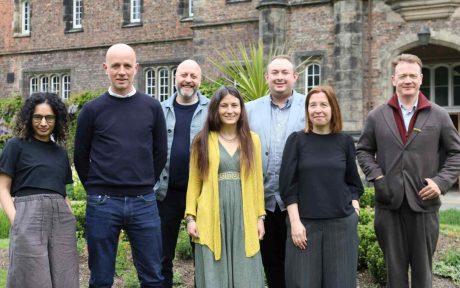
This week in May 2026, the AHRC-funded Creative Writing Together project officially began. It felt genuinely exciting to travel to York St John University with our newly appointed Research Assistant, Samia Rahman, for our first major kickoff meeting with the wider project team. York St John’s proud press office have a lovely update here.
The project has been years in the making, through conversations, drafting, redrafting, dreaming, problem solving, and collaboration. To finally sit together in the beautiful surroundings of York St John, surrounded by colleagues who are committed to creative writing, reflective functioning, wellbeing, education, and social change, felt deeply energising.
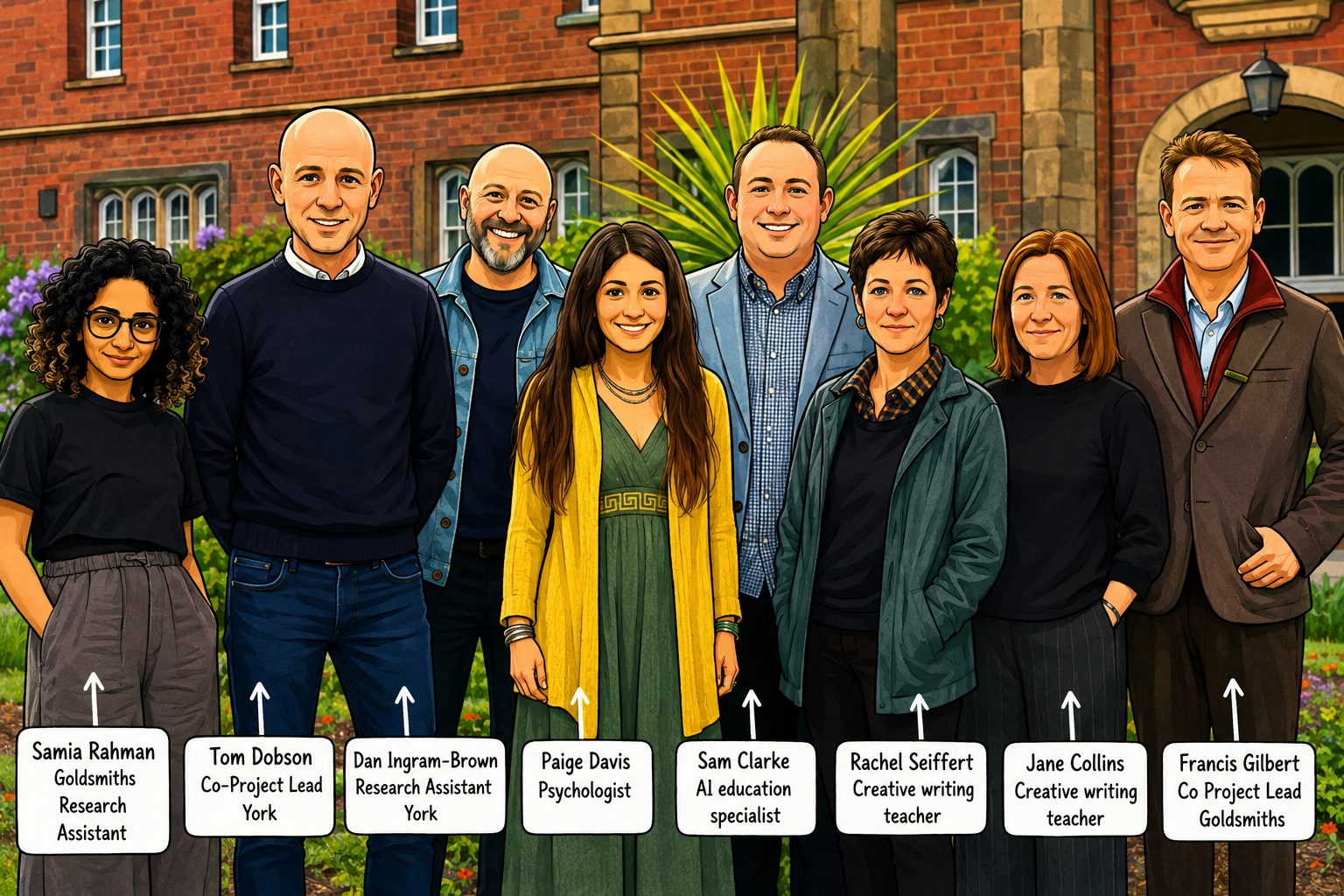
As co-project lead, I was especially delighted that we were able to appoint two outstanding colleagues at Goldsmiths. Samia Rahman will work on the project for three years at 0.5 FTE as Research Assistant, and the novelist and creative educator Rachel Seiffert will work with us one day a week across the life of the project. Their insight, creativity and commitment will be central to the work ahead.
We met with Tom Dobson, whose vision, energy and leadership have played a central role in shaping the project from its inception. The meeting brought together a rich interdisciplinary team, reflecting the collaborative and imaginative spirit of the work itself.
Also present were Jane Collins (Rachel’s counterpart being the creative writing teacher) and Dan Ingram-Brown (Samia’s counterpart being a post-doctoral assistant). Significantly, both Dan and Jane are contributing their expertise in creative writing pedagogy and research. We were joined by the psychologist Paige Davis, who is leading on the project’s reflective functioning and evaluation work, helping the team think carefully about the emotional and relational dimensions of learning.
The digital and technological side of the project was represented by Sam Clarke, whose thoughtful approach to AI and education is helping shape the project’s ethical and pedagogical framework. We also met with Andrew Stafford and Thomas Eagle, who are developing the project’s online infrastructure and digital presence.
In addition, we met online with Georgia Cowley, whose distinctive visual imagination and design expertise will help develop the project’s visual identity and public facing materials.
Here are seven things I learned from our first week together.
1. Creative writing projects are built through relationships
One thing that struck me repeatedly during the meeting was how much this project depends upon trust, dialogue, generosity and collaboration.
Large grants can sometimes seem abstract when written on paper. But sitting together in the York St John quad, talking through ideas over coffee, discussing anxieties honestly, and beginning to imagine workshops and schools together, reminded me that educational research is fundamentally relational.
Creative Writing Together is not simply a research project. It is a community in formation.
2. Reflective functioning matters enormously
One of the most fascinating discussions centred around reflective functioning, a well established psychological framework connected to empathy, emotional understanding, attachment and wellbeing.
We explored research from the York St John pilot project showing how reflective functioning can help people better understand both themselves and others. The evidence suggested that when people develop stronger empathetic capacities, their wellbeing often improves too.
This feels especially important at a time when many young people, teachers and families are dealing with anxiety, disconnection and emotional overload.
Creative writing may offer a uniquely powerful space for reflective functioning because it allows people to inhabit perspectives beyond their own.
3. Writing from another perspective changes you
During one workshop activity, we looked at an image of fire burning in a field and wrote creatively from two different perspectives.
Samia and I paired together. I first wrote from the perspective of the fire itself, destructive, hungry, alive with movement. Then I rewrote the scene from the viewpoint of a field mouse caught within the blaze.
The emotional shift was immediate.
The exercise reminded me how creative writing allows us to practise forms of empathy that are imaginative, embodied and emotional rather than merely abstract. You do not simply discuss another viewpoint; you attempt to live it for a moment through language.
That process can be transformative.
4. Free writing still has extraordinary power
I also led a short session inspired by Gillie Bolton’s work on free writing and therapeutic writing practices.
We explored writing “through the mirror”, encouraging participants to move quickly between perspectives and voices without over editing or censoring themselves. The writing generated in the room was vivid, surprising and emotionally rich.
What struck me again was how quickly creative writing bypasses performance language. Once people are given permission to write freely, unexpected truths and connections often emerge.
In educational settings increasingly shaped by metrics, targets and assessment pressures, this kind of exploratory writing can feel radical.
5. Ethical AI requires principles, not panic
One of our most important conversations focused on AI ethics.
We discussed how AI tools might support participants who struggle with confidence, drafting or idea generation, while also ensuring that human creativity, reflection and agency remain central.
Rather than seeing AI as either wholly positive or wholly dangerous, we began discussing a set of “golden principles” for ethical use. These principles will help guide the project’s approach.
Our aim is not to replace human creativity with automated systems. Instead, we want to explore how AI might support reflective, ethical and genuinely creative processes in educational contexts.
The conversation felt thoughtful, balanced and hopeful.
6. Structure creates freedom
Another key lesson from the week was the importance of establishing clear structures early.
We discussed ethics processes, communication systems, timelines, research design, workshop planning, dissemination, school partnerships and public engagement.
Tom spoke very honestly about clearing space in his diary and saying no to other commitments in order to focus properly on the project. I found that inspiring. Large creative and educational projects need time, care and attention if they are to flourish.
Good structures do not limit creativity; they make ambitious creative work possible.
7. This project feels genuinely historic
There was a growing sense across the meeting that this project could become something very significant.
Creative Writing Together is one of the largest grants ever awarded in the field of creative writing and education. The York St John press office is already preparing publicity around the project, and there has been substantial interest from educators, researchers and practitioners.
What excites me most, however, is not simply the scale of the funding. It is the possibility that this project might demonstrate something important about creative writing itself.
Creative writing is not an “extra”. It is not ornamental.
It can help people reflect, empathise, connect, imagine differently, and understand themselves and others more deeply.
In a fragmented and anxious world, that matters enormously.
The first week of Creative Writing Together has left me feeling hopeful, energised and deeply grateful to be part of such an extraordinary team.
The real work now begins.
Leave a Reply