
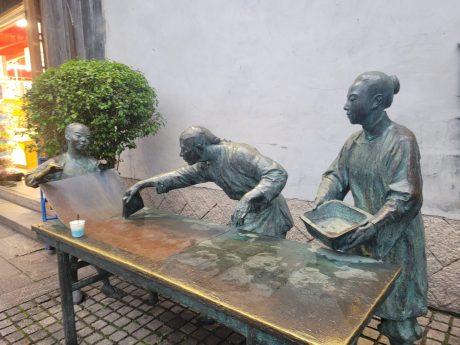
Recently, in April 2026, I spent over a week in southeastern China visiting universities in Fuzhou and Xiamen, meeting academics and students, promoting Goldsmiths, and exploring possibilities for future collaboration.
Both cities are in Fujian province, a mountainous coastal region directly across the Taiwan Strait from Taiwan, historically shaped by maritime trade, migration and cultural exchange. Fujian occupies a fascinating position within China: geographically close to Taiwan, economically connected to the great manufacturing and shipping networks of the southeast coast, yet culturally distinct from Beijing and Shanghai. Its dialects, cuisines and architecture all carry traces of centuries of seafaring openness and regional identity.
Fuzhou, the provincial capital in the north of Fujian, sits beside the Min River and has long been an important port city and gateway between inland China and the sea. Historically associated with shipbuilding, trade and educational reform, it combines sprawling modern development with older neighbourhoods shaded by banyan trees and threaded with temples and traditional tea houses.
Several hours south by high speed rail lies Xiamen, one of China’s most attractive coastal cities, built around a harbour facing Taiwan. Xiamen was one of the first Special Economic Zones established during China’s economic reforms of the 1980s, and today it feels prosperous, international and technologically advanced, while still retaining traces of its colonial and maritime past. Ferries crisscross the harbour, glass towers rise beside older villas and temples, and the subtropical climate gives the city a lush, almost Mediterranean atmosphere.
Travelling between the two cities on the Fuzhou–Xiamen high speed railway, one of the fastest coastal rail lines in China, offered its own insight into the scale and ambition of contemporary Chinese infrastructure development.
China overwhelms the senses. One moment you are gliding through a futuristic metro system beneath towers covered in neon lights; the next, you are walking beneath banyan trees beside temples, incense drifting through humid evening air.
Travelling with Yangguang Chen, lecturer on the PGCE at Goldsmiths, and her son Joe, I was fortunate enough to experience not just universities, but everyday life, meals, trains, parks, temples and conversations that revealed a far more complex and human picture of contemporary China than the clichés we often encounter in Britain.
Here are six things I learnt.
1. China feels ancient and futuristic all at once
One of the strangest and most exhilarating aspects of visiting contemporary China is the coexistence of deep history and astonishing modernity.
Fujian province, where I spent most of my time, has historically been one of China’s great maritime regions: outward looking, commercially ambitious and culturally layered through centuries of trade with Southeast Asia and beyond. That history still lingers everywhere, even amid the intense technological transformation of modern China.
We travelled on bullet trains moving at over 250 kilometres per hour along China’s southeastern coast, crossed vast cities on spotless metro systems, and navigated daily life through QR codes and digital payment apps. The infrastructure often felt years ahead of what I am used to in Britain. Entire districts appeared newly built, their glass towers and elevated transport systems glowing through subtropical rain and mist.
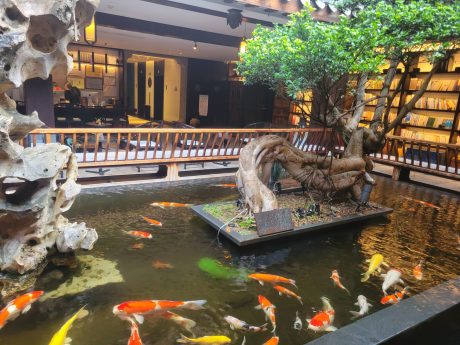
And yet, threaded through all this modernity were moments that felt almost timeless: Buddhist temples tucked beneath enormous banyan trees, elderly people practising tai chi at dawn in public parks, incense drifting through humid alleyways, and traditional tea houses standing quietly among shopping malls and office blocks.
Xiamen in particular embodied this layering of worlds. Historically a treaty port opened to foreign trade in the nineteenth century, and later one of the first Special Economic Zones established during China’s economic reforms of the 1980s, the city carries traces of both colonial history and hyper modern capitalism. Across the harbour lies Gulangyu island, once home to foreign consulates and merchants, now preserved as a UNESCO heritage site famous for its winding lanes, old villas and subtropical atmosphere.
Reaching Gulangyu by ferry, we climbed Sunlight Rock through narrow streets filled with jasmine scents, seafood stalls, tourists taking selfies, and glimpses of the sea opening suddenly between old stone buildings. From the summit, the harbour stretched out beneath us towards Taiwan, only a short distance away geographically, yet politically and historically carrying enormous symbolic weight.
China never felt like a country moving neatly from past to future. Instead, everything seemed layered together at once: empire, revolution, global capitalism, ancient ritual, digital modernity and regional history all existing simultaneously within the same streets and skylines.
2. Hospitality in China is deeply communal


One of the most memorable aspects of the trip was the extraordinary generosity and attentiveness of our hosts.
Meals in China were never simply about eating. They were rituals of welcome, friendship, respect and social harmony, shaped, I think, by deeply rooted Confucian traditions which continue to influence everyday life and relationships. Again and again, we were invited to large communal meals centred around circular tables with rotating glass platforms laden with seafood, soups, noodles, pork dishes, vegetables, dumplings and endless varieties of mushrooms and sauces.
The structure of the meal itself seemed symbolic. Nobody ordered purely for themselves. Dishes were shared collectively, offered to one another, discussed, rotated around the table. Hospitality was active and participatory. Hosts carefully watched guests to ensure they were comfortable, well fed and included. There was a strong sense that eating together was not simply social but ethical: a way of demonstrating care, mutual respect and human connection.
This emphasis on collective harmony and attentiveness to others felt very different from the more individualised dining culture we often experience in Britain. Meals stretched over hours, punctuated by conversation, laughter and repeated encouragement to try different dishes. Refusing food too firmly could even seem faintly impolite because generosity itself was being offered through the meal.
I gradually became aware that many interactions in China seemed shaped by related cultural values: respect for guests, attentiveness to hierarchy, collective responsibility and the maintenance of social harmony. Even within universities, there was often a strong sense of institutional pride and collective identity rather than the more openly adversarial or individualistic culture sometimes found in British academia.
What struck me most, though, were the smaller moments of everyday kindness that existed alongside these larger rituals of hospitality. Early in the trip, exhausted and disorientated after travelling, I struggled to navigate a digital payment system in a McDonald’s. A young employee patiently helped me sort it out, smiling throughout the whole interaction. It was a tiny moment, but one that captured the warmth, patience and generosity I repeatedly encountered throughout the journey.
3. Chinese universities are changing rapidly


The universities we visited were impressive not simply in size, but in the sheer seriousness with which education and institutional development appeared to be approached.
Fuzhou Normal University, founded in the early twentieth century and historically associated with teacher education and educational reform in Fujian province, occupies both an older, historically layered campus in the city centre and a vast newer campus on the outskirts of the city. Xiamen University, meanwhile, is widely regarded as one of China’s leading universities, famous not only for its academic reputation but also for its spectacular coastal setting and its role within China’s modernisation and internationalisation projects. Founded in 1921 by the overseas Chinese businessman Tan Kah Kee, it has long embodied connections between China, diaspora communities and global education.
Both universities combined huge student populations, modern facilities, technologically sophisticated teaching spaces and visible investment in research infrastructure. There was a palpable sense of ambition and confidence. Campuses felt alive late into the evening, full of students studying, exercising, eating together and socialising in carefully maintained public spaces.
What also struck me was the scale on which Chinese higher education now operates. Since the 1990s, China has massively expanded its university sector, investing heavily in research, postgraduate education and international competitiveness. Projects such as the former “Project 211” and “Project 985”, and more recently the “Double First Class” initiative, have channelled enormous state investment into creating globally competitive universities. In practical terms, this means Chinese students increasingly have access to high quality postgraduate education within China itself, often at a fraction of the cost of studying abroad.
That changing landscape formed an important backdrop to many of our conversations.
British universities are still respected in China, particularly institutions associated with creativity, critical thinking and international prestige. Goldsmiths, with its reputation for the arts, humanities and teacher education, continues to carry significant cultural capital. Yet there was also a clear sense that relationships between Chinese students and UK universities are shifting.
Several academics and students hinted, sometimes diplomatically, at growing concerns around:
• rising international tuition fees
• the extraordinary cost of living in London
• changing visa and immigration policies
• perceptions of declining student satisfaction in the UK
• the increasing quality and confidence of Chinese postgraduate education
There also seemed to be a growing pragmatism among students and families. In previous decades, studying in Britain may have carried an almost automatic prestige. Now the calculation appears more complex. Students are asking harder questions: What exactly are we paying for? What opportunities will this degree create? Is the student experience genuinely worth the financial sacrifice?
This creates both a challenge and an opportunity for universities like Goldsmiths.
The days when British universities could assume automatic authority in the global education market may well be fading. Institutions increasingly need to articulate clearly what makes them intellectually and culturally distinctive. In Goldsmiths’ case, I found myself speaking less about rankings or prestige, and more about creativity, interdisciplinarity, critical inquiry, diversity and London itself as a cultural environment.
Interestingly, those qualities still seemed to resonate strongly with many of the students we met. What attracted them was not necessarily institutional conservatism or hierarchy, but the possibility of intellectual openness, experimentation and personal transformation through education.
That, perhaps, remains one of the most valuable things British universities can still offer.
4. Britain could learn from China’s infrastructure


To understand contemporary China, I increasingly felt, you have to hold several historical eras in your mind simultaneously.
China often appeared to me as an extraordinarily ancient civilisation moving at immense technological speed, while still carrying the psychological and political aftershocks of the twentieth century. The past never seemed fully past. It lingered in symbols, rituals, architecture, conversations and public memory, sometimes spoken openly, sometimes indirectly.
The presiding historical presence, inevitably, is Mao Zedong.
From a Western perspective, Mao is often understood primarily through catastrophe: the Great Leap Forward, famine, ideological repression and, above all, the Cultural Revolution of the 1960s and 70s, when intellectuals, teachers and institutions were attacked in the name of revolutionary purity. In Britain, Mao’s image largely signifies authoritarianism and political extremism.
In China, however, the picture is far more complicated and emotionally layered.
Mao still appears everywhere: his portrait overlooking Tiananmen Square in Beijing, his image on banknotes, posters in shops and restaurants, references in museums and historical sites. He remains, in a sense, a symbolic father of modern China, the revolutionary leader associated with ending foreign domination, unifying the country and restoring national dignity after what Chinese history often describes as the “Century of Humiliation”, the long period of imperial decline and foreign intervention stretching from the Opium Wars into the twentieth century.
Several Chinese people I spoke with seemed to hold contradictory views simultaneously: recognising the suffering and chaos associated with the Cultural Revolution while also respecting Mao as the figure who laid the foundations for a more unified and powerful China.
Interestingly, Mao himself wrote extensively about contradiction. His 1937 essay “On Contradiction”, influenced by Marxism but also shaped by older Chinese philosophical traditions, argued that societies develop through tensions and opposing forces existing simultaneously. Walking through modern China, I sometimes felt that Mao’s theory of contradiction still hovered symbolically over the country itself: communism and capitalism, collectivism and consumerism, nationalism and globalisation, ancient ritual and digital modernity all coexisting uneasily but dynamically.
The shadow of later historical moments also seemed quietly present.
Although nobody directly discussed Tiananmen Square with me, its absence from conversation carried its own kind of presence. Likewise, Deng Xiaoping’s economic reforms from the late 1970s onwards, which transformed China into an economic superpower while maintaining one party political control, felt visible everywhere in the vast infrastructure projects, booming cities and market driven consumer culture.
One of the strangest cultural reversals for a Western visitor is the way figures such as Richard Nixon and Henry Kissinger are often viewed relatively positively in China because of their role in reopening diplomatic relations between China and the United States during the 1970s. In Britain and America, Kissinger in particular remains highly controversial, associated by many with Cold War realpolitik and military interventions abroad. Yet within China, the Nixon visit can appear instead as a pivotal moment of international recognition and strategic respect.
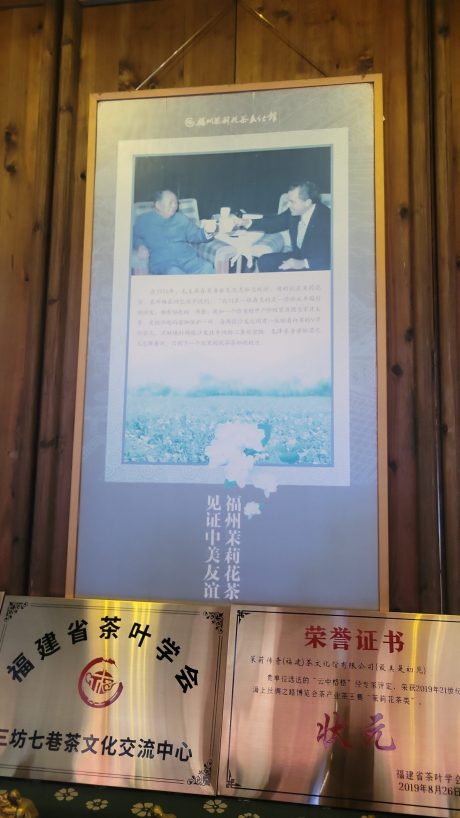
That difference in historical perspective fascinated me. The same historical figures carry entirely different emotional and political meanings depending on where you stand.
What struck me throughout the trip was not simply that China is “modernising”. That word feels far too simple. Rather, contemporary China seems to contain multiple historical layers simultaneously: Confucian traditions of hierarchy and harmony, revolutionary communist history, traumatic collective memory, rapid capitalist development, digital surveillance systems, intense nationalism and genuine openness to technological and educational innovation.
Walking through cities like Fuzhou and Xiamen, with their temples beside skyscrapers and ancient tea houses beneath neon towers, I often felt that the country was not leaving its past behind so much as carrying all its pasts forward at once.
5. Technology shapes everyday life in fascinating ways


A Chinese temple made out of chocolate
China felt intensely digital in a way that went far beyond anything I had previously experienced in Europe.
In Britain, digital technology still tends to sit on top of older systems. You can usually choose whether to use cash or card, whether to book online or in person, whether to rely on apps or not. In China, by contrast, digital infrastructure seemed to underpin almost every aspect of daily life. The smartphone is not simply a convenience there; it is effectively an extension of citizenship and social participation.
Payments, transport systems, tickets, restaurant ordering, messaging and even entry into certain buildings relied heavily on apps and QR codes, especially through platforms such as WeChat and Alipay, which combine messaging, banking, ticketing, shopping and social media into enormous self contained ecosystems. It quickly became clear that much of contemporary Chinese life functions within Chinese technological systems largely separate from Western digital infrastructure.
As a foreign visitor, this was fascinating but also occasionally disorientating.
My British bank cards often failed unexpectedly. Google services barely functioned without a VPN. Gmail was inaccessible. Even simple things like ordering coffee or buying train snacks became unexpectedly complicated if you did not possess the right apps, linked to the right forms of identification and payment. At one McDonald’s, I found myself completely unable to navigate the ordering system until a young employee kindly intervened and helped me through the process.
The deeper I travelled into the country, the more I realised how technologically self sufficient China has become. In the West, we often unconsciously assume that American digital systems are universal: Google, Apple, Visa, WhatsApp, Instagram, Gmail. China has effectively built parallel versions of many of these systems, operating at enormous scale for over a billion people.
This digital independence is partly historical and political. Since the early 2000s, China has developed what outsiders often call the “Great Firewall”, restricting or blocking many Western internet services while encouraging domestic alternatives to flourish. Companies such as Tencent, Alibaba and Huawei emerged within this protected ecosystem and are now among the largest technology companies in the world.
The result is a digital environment that can feel astonishingly efficient from within. Public transport integration, mobile payments and app based services often worked seamlessly for Chinese users around me. The speed and convenience were genuinely impressive.
At the same time, as a Western visitor, I became very aware of how closely digital systems, identity verification and public life are intertwined in China. Everyday activities frequently required forms of registration, verification or scanning that felt unfamiliar to me coming from Britain. There was a stronger sense that the digital world and the state operate in close relationship rather than as separate spheres.
This inevitably raises difficult questions about privacy, surveillance and freedom, especially from a Western liberal perspective. Yet I also became conscious that Western societies are hardly free from large scale digital monitoring themselves. British and American citizens are also constantly tracked through smartphones, social media platforms, banking systems and data harvesting by corporations, even if this monitoring is less visibly integrated into state structures.
What differed in China was perhaps not simply the existence of surveillance, but its visibility and normalisation within everyday life.
Rather than reducing this to easy political judgments, I found myself reflecting on how every society balances convenience, security, collective organisation and individual freedom differently. China’s digital systems seemed to embody a broader cultural emphasis on coordination, order and collective functionality, while Western societies often place greater rhetorical emphasis on individual autonomy, even as they remain deeply dependent on technological monitoring themselves.
Again and again during the trip, I found myself returning to the same conclusion: contemporary China is best understood not through simple binaries of freedom versus control, or modernity versus authoritarianism, but through contradiction, hybridity and scale. It is a civilisation with ancient roots that has built one of the most technologically sophisticated societies on earth within the space of a few decades.
6. Travel makes you see your own country differently

The most valuable thing about travel is not simply seeing another country. It is returning to your own country with altered eyes.
Before travelling, I had dipped into the Lonely Planet Guide to China, partly for practical advice, but also because guidebooks quietly shape how we imagine countries before we encounter them ourselves. I had also watched Michael Wood’s documentaries on Chinese history, which emphasise the immense historical continuity of Chinese civilisation: dynasties rising and falling, philosophical traditions enduring across millennia, and the extraordinary scale of China’s cultural memory. The accompanying book, The Story of China, is highly readable, journalistic and comprehensive. Alongside this, I had been reading The Chinese Myths, the beautifully produced Thames and Hudson guide to Chinese gods, legends and cosmology, which opened up an imaginative world of dragons, immortals, spirits, sacred mountains and cosmic balance that still lingers beneath aspects of contemporary Chinese culture.
Among contemporary writers, Colin Thubron probably remains the great British literary traveller of China and Inner Asia. His Behind the Wall: A Journey Through China and later works on Tibet and the Chinese borderlands capture something essential about the scale, loneliness and historical depth of the country. Thubron often writes as though travelling through layers of civilisation and memory simultaneously, attentive not only to politics but to silence, landscape and emotional atmosphere.
Peter Hessler, by contrast, offers a more intimate and sociological portrait of modern China. Living and teaching in Chinese universities for years, Hessler documented ordinary lives during the country’s extraordinary economic transformation, especially in River Town, Oracle Bones and Country Driving. What makes Hessler so valuable is his refusal to reduce China to ideology alone; he writes instead about students, teachers, factory workers, migrants and families negotiating bewilderingly rapid change.
Jonathan Spence, though primarily a historian rather than a travel writer, also shaped how many Western readers understand China historically. His work repeatedly emphasised how difficult it is for outsiders to interpret China through simplistic Western frameworks.
Travelling through Fujian province, I found myself thinking often about these writers, because contemporary China constantly resists easy interpretation.
What struck me repeatedly was not simply “difference”, but contradiction and simultaneity.
I encountered a society that was intensely modern yet deeply historical; technologically sophisticated yet shaped by ancient philosophical traditions; highly collective in some respects while also fiercely entrepreneurial and competitive. In cities such as Xiamen, with colonial era villas standing beside giant shopping malls and forests of glass towers, it often felt as though several centuries were coexisting at once.
Interestingly, I also became aware of how strongly certain aspects of Victorian Britain still appear to influence Chinese ideas of modernity and development. Nineteenth century Britain is remembered in China not only as an imperial aggressor during the Opium Wars, but also as the first great industrial and maritime power of the modern age. Railways, ports, engineering, manufacturing, naval strength and global trade all became associated with national power and prestige.
In some respects, contemporary China seems to have studied that developmental history with extraordinary seriousness. The vast infrastructure projects, technological ambition, educational expansion and global trade networks visible across modern China sometimes feel like a twenty first century reimagining of the industrial energy once associated with Victorian Britain, though operating on a vastly larger scale and under very different political conditions.
Yet the old colonial relationship has also unmistakably reversed.
Historically, places such as Xiamen and nearby Gulangyu island were shaped heavily by European and Japanese colonial presence. Gulangyu in particular became an international settlement after the Opium Wars, filled with consulates, churches, missionary schools and European villas. Today, however, these sites no longer feel like colonial outposts gazing into China. They have been culturally absorbed back into a confident Chinese national narrative.
What fascinated me was how Asian the tourist world there now feels. The crowds filling ferries, heritage sites, beaches and shopping streets in April were enormous, but the vast majority were domestic Chinese tourists or visitors from elsewhere in East and Southeast Asia: Thai, Vietnamese, Taiwanese and others. Western tourists were comparatively rare.
This subtly alters the emotional atmosphere of travel itself.
For earlier Western travel writers, China often appeared remote, mysterious or partially inaccessible. Today, in places like Xiamen, one increasingly feels the West is no longer the central reference point. China is part of a huge Asian economic and cultural sphere with its own internal tourism, technological systems and regional networks operating at immense scale.
That shift fascinated me.
At times, travelling there as a British academic carried a strange historical doubleness. Britain once approached China through assumptions of imperial superiority, missionary confidence and commercial dominance. Contemporary British visitors arrive in a rather different position: economically smaller, infrastructurally weaker in some respects, and often looking towards China with a mixture of admiration, uncertainty and anxiety.
I came away admiring many things: the infrastructure, the hospitality, the seriousness with which education is approached, the beauty of public parks and civic spaces, and the astonishing pace of development.
At the same time, the trip also reminded me how much I value certain aspects of British academic and cultural life: informality, eccentricity, humour, openness of debate and intellectual independence.
Travel complicates certainty. That is one reason it matters.
And perhaps universities matter for similar reasons too. At their best, they allow people from very different cultures, histories and political systems to encounter one another thoughtfully, critically and humanely, not in order to erase difference, but to understand it more deeply.
Leave a Reply