
For
target readership of the post
-
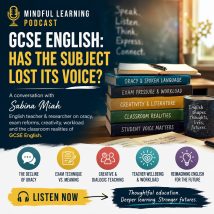
The Mindful learning podcast: Five Things You Should Know About GCSE English, Oracy and the Future of Education
In this episode of the Mindful Learning Podcast, I speak with English teacher and researcher Sabina Miah about GCSE English, oracy, creativity, workload, and what is happening inside English classrooms today. Sabina trained on the PGCE English programme at Goldsmiths and is now researching the impact of GCSE English Language reforms on teachers’ pedagogy and classroom practice. Together we explore the disappearance of coursework, the marginalisation of spoken language, the rise of “technique spotting”, silent classrooms, teacher exhaustion, and what all this means for young people. Sabina speaks candidly about the pressures facing teachers today, describing how she developed a “teacher autopilot” simply to survive the workload, while still finding meaning in “those little interactions with the students”. We discuss whether English teaching has become too formulaic, why oracy matters for democracy and social mobility, and how many classrooms have become increasingly compliance-driven. At the same time, the conversation is hopeful. We explore how English could once again become a creative, dialogic subject rooted in debate, drama, discussion, empathy, media literacy, and genuine human expression. This podcast will resonate with teachers, parents, policymakers, students, and anyone interested in the future of education. https://www.francisgilbert.co.uk/2026/05/the-mindful-learning-podcast-five-things-you-should-know-about-gcse-english-oracy-and-the-future-of-education/
-
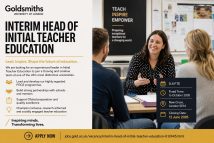
Interim Head of Initial Teacher Education Required at Goldsmiths, Join One of the UK’s Most Creative Teacher Education Communities
Goldsmiths is recruiting an Interim Head of Initial Teacher Education. This is an exciting opportunity to join one of the UK’s most creative and research-rich teacher education communities, helping lead our highly regarded PGCE programmes and shape the next generation of teachers. The advert for the role is here, https://jobs.gold.ac.uk/vacancy/interim-head-of-initial-teacher-education-612445.html
-

Six Things I Learnt Visiting Chinese Universities and Promoting Goldsmiths in China
Recently I spent over a week visiting universities in southeastern China, travelling through Fuzhou and Xiamen promoting Goldsmiths and exploring new educational partnerships. What I encountered challenged many of my assumptions about contemporary China. This was a country that felt simultaneously ancient and futuristic: bullet trains travelling at over 250 kilometres per hour, QR codes governing everyday life, giant digital infrastructures, but also temples filled with incense, banyan shaded parks, Confucian traditions of hospitality and colonial era streets overlooking the Taiwan Strait. I reflect on the extraordinary communal culture around food, the sheer scale of Chinese universities, the rise of China’s own postgraduate sector, and the way figures such as Mao, Deng Xiaoping, Nixon and Kissinger still haunt the political and historical imagination in very different ways from the West. I also explore how China’s technological self sufficiency, from WeChat to digital payments, creates a society that is both incredibly efficient and deeply distinctive from Europe or America. Along the way, I found myself thinking about great travel writers such as Colin Thubron and Peter Hessler, and how travel changes not just our understanding of another country, but of our own.
-
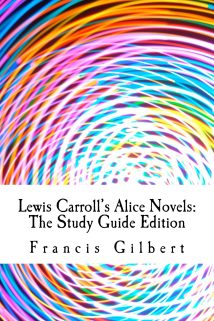
Lewis Carroll’s Alice Novels: The Study Guide Edition
Step into Wonderland with a fresh, interactive approach to Lewis Carroll’s classic novels. Lewis Carroll’s Alice Novels: The Study Guide Edition combines the complete texts of Alice’s Adventures in Wonderland and Through the Looking-Glass with commentary, creative activities, teaching ideas and discussion questions designed to deepen readers’ understanding and enjoyment. Rather than simply summarising the stories, the book explores themes such as identity, dreams, nonsense, childhood, power and imagination, encouraging readers to think critically and creatively about Carroll’s strange and enduring worlds. Ideal for students, teachers, trainee teachers and lovers of children’s literature.
-

Five Things FE Teachers Can Learn from Small Scale Research
As part of the British Library’s Learning Skills Research Network, Debbie Bogard and I co-led an online Learning and Skills Research Network session exploring research methods and data collection in Further Education. At first I joked that research methods might not be the most thrilling topic. Yet the discussion quickly showed the opposite. When research begins with real classrooms, real teachers, and real learners, it becomes deeply engaging. The session centred on a simple but powerful idea. Small scale practitioner research can generate profound insight. FE classrooms are rich research sites where teachers already observe patterns, dilemmas, and possibilities every day. Research is not something distant or purely academic. It begins with curiosity about practice. Five themes emerged strongly. First, FE classrooms contain valuable knowledge worth studying. Second, the research question matters more than the method. Third, teacher voice is not decoration but a form of data that reveals how systems actually operate. Fourth, ethics sit at the centre of practitioner research because education is fundamentally relational. Finally, research can be empowering. In systems shaped by accountability pressures, inquiry allows teachers to step back, reflect, and understand their work more deeply. The workshop reminded us that practitioner research is not about grand projects. It is about paying attention to practice and learning from it together.
-

Why Creative Writing Together Matters, A £1m Research Project for Families, Schools and Communities
I am delighted to share that Professor Tom Dobson and I, working with an exceptional interdisciplinary team, have secured close to £1 million in funding for a three year research project, Creative Writing Together. This major award supports an ambitious investigation into how creative writing can strengthen relationships between children, parents, teachers and communities, and enhance wellbeing across educational settings. At a time when schools and families are facing rising mental health challenges, increasing absence and deepening inequalities, we are asking a simple but powerful question. What if creative writing were treated not as an optional enrichment activity, but as a relational practice that helps people understand themselves and one another more deeply? The project centres on the concept of reflective functioning, the capacity to make sense of behaviour in terms of thoughts, feelings and intentions. Strong reflective functioning is associated with secure attachment, improved relationships and emotional regulation. Yet creative writing has rarely been studied as a preventative, community based approach to developing these capacities. Over three years, we will run eight week programmes in schools and community centres in London and York, bringing families and teachers together to write collaboratively. Combining action research, psychological measures and close analysis of participants’ writing, we aim to generate robust evidence and practical resources that can inform policy and practice. Creative Writing Together positions writing as a shared, transformative act. In a fragmented educational landscape, it offers a hopeful vision of creativity as connection.
-
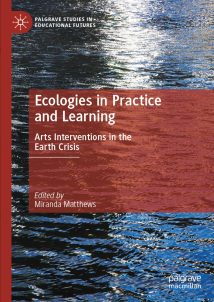
Ecologies of Practice and Learning (Book chapter)
How can creative research help young people become agents of environmental change? This post highlights a chapter I co-authored with Anna Stewart in the edited collection Ecologies in Practice and Learning: Arts Interventions in the Earth Crisis. The book brings together arts educators, researchers and practitioners exploring how learning, creativity and ecological action intersect in a time of environmental crisis. Our chapter draws on the Parklife project, where young people aged eleven to fourteen became co-researchers into a local park. Using poetry, art, film, photography and surveys, they explored safety, ecology and belonging, and presented their findings directly to decision-makers. The result was real change on the ground. The chapter argues for creative, participatory research as a powerful tool for environmental education and democratic engagement, and for parks as classrooms without walls. You can read and download the full article via my website.
-
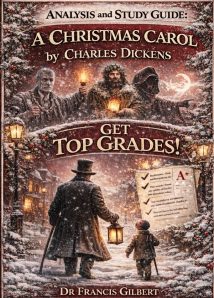
Analysis and Study Guide: A Christmas Carol by Charles Dickens
This new ‘Analysis and Study Guide to A Christmas Carol’ is written to help GCSE students genuinely understand Dickens’ novella and write confident, high-level exam responses. It draws directly on my experience teaching ‘A Christmas Carol’ for over twenty years in secondary classrooms, alongside my work as an academic at Goldsmiths where I research the best ways to teach diverse cohorts. Unlike formulaic revision guides, this book focuses on ideas, argument and clarity. It shows students how Dickens shapes meaning through structure, language, character and context, without reducing the novel to lists of quotes or rigid paragraph templates. Each section models the kind of thinking examiners reward, from building a clear thesis to selecting evidence that genuinely supports an argument. The guide includes detailed contextual explanations, accessible critical perspectives, close language analysis, character studies, theme exploration, exam style questions with guidance, creative tasks and speaking activities. The complete text of ‘A Christmas Carol’ is included, with clear, supportive annotations throughout. Written in an encouraging, student friendly voice, this guide works equally well for independent revision, classroom teaching and last minute consolidation. It is ideal for GCSE students aiming for top grades, and for teachers looking for a rigorous, readable resource grounded in real classroom practice.
-
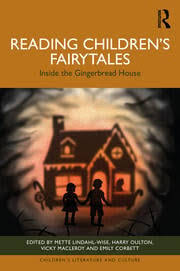
Reading Children’s Fairytales: Inside the Gingerbread House (Chapter)
It’s been a real privilege to contribute to Reading Children’s Fairytales: Inside the Gingerbread House (Routledge), a genuinely collaborative and intellectually generous volume edited by an outstanding team with strong roots in Goldsmiths, University of London. The book is edited by Dr Mette Lindahl-Wise and Dr Harry Oulton, both PhD graduates of Goldsmiths’ Education department, alongside Professor Vicky Macleroy, now Emerita Professor and still a hugely influential presence in the field, and Dr Emily Corbett, Head of the MA in Children’s Literature and a tireless champion of children’s and young adult literature. Their collective vision has shaped a book that is rigorous, creative, inclusive, and genuinely interdisciplinary. The volume brings together leading and emerging scholars, practitioners, and creative writers to explore the enduring power of Hansel and Gretel across children’s and young adult literature, art, and culture. It includes a chapter by Professor Michael Rosen and an introduction by Jack Zipes, widely regarded as the world’s leading authority on fairy tales, setting the intellectual tone for the collection. Across the book, contributors examine retellings of Hansel and Gretel in picturebooks, graphic novels, poetry, YA fiction, sculpture, and Hip-Hop, challenging narrow, hierarchical, and canonical approaches to fairy tales. The result is a rich, dialogic collection that celebrates multiple forms of knowledge, multimodal meaning-making, and culturally responsive approaches to children’s and young adult literature. If you’re reading this on Instagram, please paste the link into your browser to access the full article.
-
7 Ways For Teachers to become Researchers
In December 2025, I delivered an online session for FE lecturers as part of the British Library Research Network, working with Debbie Bogard of the British Library. We explored seven things every teacher should know about research, using the original Alice in Wonderland manuscript as a metaphor for how inquiry really works. Research is never perfect or polished. It is exploratory, creative, full of revision and curiosity, just like a teacher’s everyday practice. We introduced practical ways to develop a research question, map its key ideas, choose an appropriate methodology, evaluate the credibility of data, and create a meaningful literature review. We also encouraged lecturers to think about more imaginative forms of sharing findings, including podcasts, infographics and multimodal projects. Examples from the Parklife project showed how creative participatory research can have a significant impact on communities and young people. The central message of the session was that research is an act of professional courage. It is not reserved for academics. With the support of the British Library Research Network, FE educators can shape their own inquiries, strengthen their critical thinking, and generate new knowledge that benefits learners and the wider sector.
-

The Healing Dance: Human Givens, Catharsis, and the Power of Stories
After more than thirty years of teaching, writing, and listening to people share their work and their worries, I’ve come to believe that stories don’t just entertain or instruct us; they heal us. In this post, I explore how narrative and imagination can restore emotional balance, drawing on my recent training in the Human Givens approach to therapy. During one of my training sessions, I worked with a woman I’ll call Anna, a dance teacher who had been sidelined by a younger colleague. I invited her to relax and told a simple story about a dancing queen who built a palace of movement and joy. When a former pupil tried to claim the palace as her own, the queen didn’t fight, she danced again. Her rhythm filled the hall and reminded everyone where the music had begun. As Anna listened, tears came — not from distress, but from recognition. The story acted as a mirror, reflecting her creative worth back to her. It wasn’t interpretation that healed her, but the moment when the story met the truth she’d carried inside all along. From Aristotle’s notion of catharsis to modern neuroscience and the Human Givens idea of “raising the emotional template,” this post explores how guided story and metaphor can help us complete interrupted stories, transforming chaos into coherence. When we re-story our experiences with compassion, the body listens, and healing begins.
-
Five Things I Learnt from Running My Workshop at Ecology in the Art Curriculum event
Begin with breathing, end with agency Our recent CPD, run by the British Ecological Society, the Centre for Arts and Learning, the MA in Art and Ecology, and the PGCE Art and Design programme at Goldsmiths, brought together teachers, artists, and ecologists to explore how mindfulness and creative pedagogy can help students reconnect with the natural world. We began simply, with a 7–11 breathing pattern, in for seven, out for eleven, and the room shifted. Teachers found themselves calmer, more attentive, and ready to imagine. A guided visualisation led participants into remembered or imagined parks, awakening ecological awareness. One delegate described how “thinking about ecology in architecture always meant thinking about care, what lives around our buildings.” From that mindful pause grew dialogue, drawing, and story. Participants wrote, sketched, and mapped experiences of safety, resilience, and belonging. Multimodality helped everyone find a voice, whether through words, images, or textures, and teachers began to see how pupils could express complex feelings about public space. Stories carried particular weight. The tale of the cracked pot, a vessel that leaks water and nurtures flowers on its path, became a metaphor for resilience and repair. Teachers shared their own narratives of strength and imperfection, connecting personal reflection with community action. By the end, delegates were planning how to adapt these approaches in their own settings, mapping safe routes with pupils, collaborating with councils, and gathering data to balance perception and reality. Change, we realised, does not arrive as a slogan but travels through networks of small, mindful acts. As I suggest in The Mindful Creative Writing Teacher, small rituals of attention such as breathing, noticing, and creating build agency. They help us move from reflection to action, from seeing to doing, with care.
-
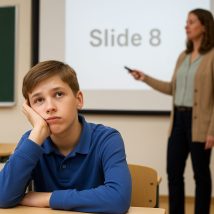
Five Things the New Are You on Slide 8 Yet? Report Can Teach Us About Learning in Schools
In this new episode of the Mindful Learning Podcast, I speak with Dr Sarah Pearce and Dr Anna Traianou about their powerful new report for the National Education Union, Are You on Slide 8 Yet?. The title comes from one teacher’s chilling experience: senior leaders checking through classroom doors to ensure every class was on the same PowerPoint slide. This report reveals how standardised curricula—ready-made lessons and scripts—are reshaping education across England, limiting both teacher autonomy and pupil creativity. As Dr Pearce explains, “If the children didn’t understand it, it almost didn’t matter. We had to keep going.” Teachers described feeling like “a warm body in front of the class,” stripped of professional judgement. Professor Traianou adds, “Teachers who used standardised curricula reported a reduced sense of decision-making and agency… and contrary to assumptions, no difference in workload.” The findings show that both teachers and pupils are losing opportunities for autonomy, collaboration, and meaningful talk—core elements of learning that mindfulness in education seeks to protect. We discuss the political roots of this trend, the dangers of AI-driven curriculum tools, and what mindful, human-centred education might look like instead. 🎧 Listen now to the full podcast and read the article: 👉 https://www.francisgilbert.co.uk/2025/10/five-things-the-new-are-you-on-slide-8-yet-report-can-teach-us-about-learning-in-schools If you’re reading this on Instagram, please paste the link into your browser to access the full article. #MindfulLearning #AreYouOnSlide8Yet #FrancisGilbert #Goldsmiths #Teaching #Education #NEU #CreativeEducation #TeacherVoice #MindfulTeaching #Podcast
-
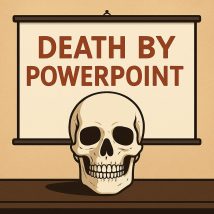
Five Big Wake-Up Calls from the New Curriculum Reports
Two major reports have shaken up the education debate in 2025. The National Education Union’s Are You on Slide 8 Yet? (Traianou, Pearce, Stevenson & Brady, 2025) lays bare the lived realities of teachers trapped in the machinery of standardisation. The government’s Curriculum and Assessment Review: Interim Report (Francis, 2025) goes further than expected, acknowledging deep systemic flaws while hinting at long-overdue reform. These reports land in a time of crisis. Child poverty is rising, teacher pay has stagnated, burnout is escalating, and authoritarian regimes of behaviour management have taken hold in many academies. AI is reshaping classrooms faster than policy can keep up. Together, these forces are eroding teacher autonomy and narrowing the curriculum’s moral and intellectual horizons. This blog identifies five urgent wake-up calls for policymakers. First, the curriculum is failing the children who need it most; inequality is widening. Second, teachers are suffering “death by PowerPoint,” stripped of agency and creativity. Third, workload has not eased; it has intensified under centralised schemes. Fourth, curriculum reform must be guided by dialogue and research, not ideology. And finally, education must equip young people to navigate an uncertain, unequal, AI-driven world. Both reports demand courage and imagination from policymakers. Incremental fixes will not be enough. At Goldsmiths, we are developing models of curriculum design that restore teacher professionalism and creativity, grounded in research-rich, socially just principles. It is time for a new settlement in education, one that trusts teachers, resists authoritarianism, and empowers young people to shape a fairer future. If you’re reading this on Instagram, please paste the link into your browser to access the full article.
-
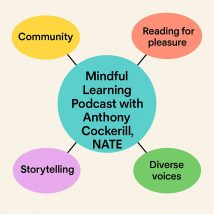
Five Things English Teachers Can Teach Us About Reading, Writing, and Living
I recorded this episode of the Mindful Learning Podcast with Anthony Cockerill, director of the National Association for the Teaching of English (NATE), because I believe English teachers have so much to teach us beyond the classroom. Our conversation was a chance to explore what reading, writing, and language mean for all of us as human beings, not just for students in schools. Anthony spoke passionately about the life-changing power of reading for pleasure, the way writing can help us respond to and reflect on life, and the importance of valuing every community’s language. He reminded me that stories shape who we are and that teaching thrives best in community, not in isolation. These are not just classroom lessons — they are life lessons. I wanted to share this podcast because, at a time when education is often framed in narrow, utilitarian terms, we need to remember the broader value of English. Reading, writing, and language are not luxuries; they are ways of being human, of building empathy, resilience, and imagination. Listen to the full conversation and read the blog here: 👉 https://www.francisgilbert.co.uk/2025/09/five-things-english-teachers-can-teach-us-about-reading-writing-and-living/
-
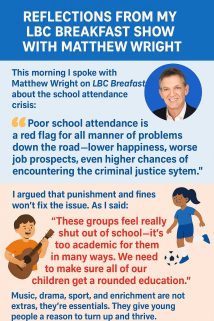
Five Ways to Improve School Attendance
Reflections from my LBC Breakfast Show with Matthew Wright (31 August 2025) This morning I spoke with Matthew Wright on LBC Breakfast about the school attendance crisis. Matthew warned: “Poor school attendance is a red flag for all manner of problems down the road—lower happiness, worse job prospects, even higher chances of encountering the criminal justice system.” I argued that punishment and fines won’t fix the issue. As I said: “These groups feel really shut out of school—it’s too academic for them in many ways. We need to make sure all of our children get a rounded education.” Music, drama, sport, and enrichment are not extras, they’re essentials. They give young people a reason to turn up and thrive. 👉 If you’re reading this on Instagram, please paste the link into your browser to access the full article on francisgilbert.co.uk .
-
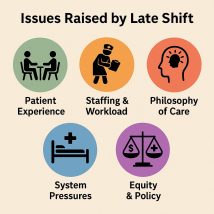
Five Things I Learnt About Life and Death from the Extraordinary New Film Late Shift
I watched Late Shift (Heldin) at the Alnwick Playhouse and left feeling that everyone in the audience had witnessed life and death together. The film follows Floria, a nurse on the night shift in a Swiss hospital, navigating impossible workloads, patients in pain, angry relatives, and small flashes of compassion. It is both realistic and mythic, a kind of modern Inferno. The film made me reflect on how much we ask of nurses, how dying can be managed well or badly, and how much society needs to decide what we truly want to fund in healthcare. Dignity at 3 a.m. should be a public right, not a private upgrade. Read the full blog on my site: www.francisgilbert.co.uk
-

Seven Things I Learnt from Land of the Free? Trump’s War on Press, Protest and Academic Freedom
What does freedom of expression really mean in 2025? On August 5th, I attended a deeply thought-provoking event hosted by Index on Censorship at St John’s Church, Waterloo, where my wife Erica Wagner was one of the speakers. The panel launched the new Index issue titled Land of the Free? and gathered journalists, editors, and activists to reflect on Donald Trump’s legacy and the erosion of civil liberties across the US and UK. From SLAPP lawsuits to the criminalisation of protest, the conversation reminded us that freedom is not a given: it must be defended, questioned, and collectively sustained. This blog distils seven key lessons I took away from the night, ranging from the legacy of the War on Terror to the global assault on so-called “woke” values. #FreedomOfExpression #IndexOnCensorship #LandOfTheFree #ProtestRights #SLAPPs #CultureWars #Democracy #WritersLife #PoliticalWriting #CreativeNonfiction #EricaWagner #FrancisGilbert #HumanRights #SpeakUp #UKPolitics #USPolitics
-

Seven Things Every Parent Should Know About Teachers and Their Children’s Learning
As a teacher, parent, and author of The Mindful English Teacher, I have seen first-hand how much pressure modern education places on families, and how little space there often is for listening, creativity, and emotional understanding. I created this podcast and companion blog to open up a more compassionate conversation between parents and teachers. Speaking with Yundie Fei, a brilliant former student of mine and now an educator working closely with Chinese families, helped me reflect on how deeply similar our experiences are across cultures. We both see the anxiety, the over-scheduling, and the miscommunication; and we both believe things can change. This is for any parent who has ever worried their child is “falling behind,” questioned a teacher’s methods, or wondered how best to support learning at home. I hope it brings reassurance, insight, and perhaps even a sense of relief: you are not alone, and there is a gentler, more mindful way forward.
-

Five Things Caves Can Teach Us About Our Lives on the Surface of Things
This summer I descended into the Postojna caves in Slovenia and came back with more than just photos. I wrote a poem and a reflection on what caves can teach us about the surface of our lives: about time, silence, the unconscious, and the power of slowness. From Plato’s shadows to Blake’s infernos, from Freud’s depths to Fingal’s Cave, this blog explores how caves have always shaped our stories and our inner worlds. A piece for anyone drawn to the poetic, the meditative, and the quietly transformative. If you’re reading this on Instagram, the link won’t work here; please paste it into your browser or visit www.francisgilbert.co.uk