

I came out of Inter Alia at the National Theatre feeling shaken, saddened and oddly recognised. Suzie Miller’s play is ostensibly about a judge whose son is accused of rape, but it is really about something wider and more disturbing: the impossible emotional pressures placed upon professional middle class families, particularly women.
Rosamund Pike’s performance as Judge Jessica Parks has rightly attracted enormous praise. Critics have described her performance as “electric”, “physically dynamic” and “rock-star like”, but what struck me most was her ability to show two different kinds of power at once: the authority of a senior judge and the exhausted guilt of a mother trying to hold everything together (John, 2025; Swain, 2025).
The play opens with a brilliant scene in court. Jessica is presiding over a rape case, calmly dismantling the tactics of male barristers who are attempting to undermine a vulnerable woman’s testimony. She understands how power works. She knows how language can be weaponised. She knows how to create space for truth.
Then her mobile phone lights up.
Her eighteen year old son Harry is calling repeatedly because he cannot find a Hawaiian shirt for a party.
That moment is funny, but also quietly devastating. Jessica can command a courtroom, yet she is still expected to organise the emotional and practical details of family life. The scene contains the whole play in miniature.
As reviewers have noted, the play repeatedly explores the tension between Jessica’s public authority and her domestic responsibilities (John, 2025).
The staging reinforces this brilliantly. Miriam Buether’s set begins as a polished, tasteful middle class home but gradually strips away into exposed beams and bare structures, blurring courtroom and domestic space psychologically and emotionally (Everett, 2025).
The more the play unfolds, the more the home feels like a performance.
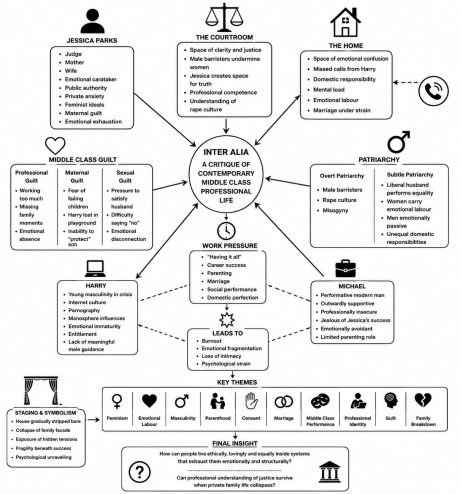
1. Middle class success still depends upon invisible female labour
Jessica is not merely successful. She is functioning as the emotional infrastructure of the entire family. She remembers everything. She manages everyone. She absorbs everyone’s anxiety. Even while handling traumatic sexual assault cases, she is expected to remain endlessly available as mother, wife, organiser and emotional caretaker. The critic Emma John perceptively notes that while Jessica prepares a dinner party for sixteen people, her husband Michael’s only responsibility is arranging the cheese delivery (John, 2025). That detail says everything.
The play exposes how many supposedly progressive middle class households still rely upon women carrying the mental and emotional load while men remain comparatively free to focus upon themselves.
2. Patriarchy has become quieter, not weaker
Michael, Jessica’s husband, is fascinating because he is not overtly monstrous. He is a very successful lawyer and is charming, intelligent and outwardly supportive. Yet he has quietly allowed Jessica to become responsible for nearly all the emotional labour in the household.
The play suggests that contemporary patriarchy often disguises itself as liberal partnership. Men can appear feminist while still benefiting from women’s exhaustion.
Rosamund Pike herself discussed this dynamic in interviews surrounding the play, arguing that women’s careers are still constantly “derailed” by expectations surrounding care, childcare and emotional availability (Agar, 2025). The play understands this deeply.
3. Boys are increasingly raised by the internet
Harry is not portrayed as a simple villain. He is needy, lonely, entitled and emotionally immature. The play asks difficult questions about where boys now learn masculinity. Suzie Miller has spoken about how many boys are “looking for male mentors” but instead receive distorted ideas about sex and women from pornography, social media and online culture (Blake, 2025).
Harry’s father performs masculinity through professional status and emotional avoidance. Jessica is overwhelmed by work and guilt. Into that vacuum floods the manosphere.
The result is horrifying because it feels plausible.
4. Professional intelligence does not save us from private collapse
Jessica understands rape culture intellectually. She has spent years judging cases involving coercion, violence and manipulation.
Yet she cannot fully see what is happening within her own family.
The recurring memory of Harry becoming lost as a small child is beautifully symbolic. Jessica fears she lost him emotionally long before the accusation emerged.
The play dismantles the comforting middle class fantasy that enough intelligence, enough parenting books, enough achievement and enough effort can somehow guarantee safety.
They cannot.
5. Work pressure is destroying intimacy
One of the most disturbing scenes occurs after a dinner party, when Michael has sex with Jessica while memories from the rape trial begin flooding into her mind. The scene is extraordinarily uncomfortable because it is emotionally ambiguous. Jessica does not want what is happening, yet she cannot articulate refusal. Michael remains oblivious to her distress.
The moment captures something painful about modern professional relationships: exhaustion has eroded emotional attentiveness. The couple are not short of money, education or cultural sophistication. They are short of time, energy and emotional presence.
6. Middle class guilt can become a permanent condition
Jessica’s guilt saturates the play. She feels guilty about work, motherhood, sex, ambition, parenting and failure. Rosamund Pike conveys this brilliantly through nervous physical movement, abrupt tonal shifts and moments of visible panic beneath professional control.
Several reviewers observed how physically relentless the role is, with Pike rarely leaving the stage as Jessica moves frantically between courtroom, kitchen and family crisis (John, 2025; Swain, 2025). The effect is exhausting to watch, deliberately so.
The play suggests that modern middle class life increasingly demands impossible forms of optimisation. Parents are expected to succeed professionally, remain emotionally available, maintain intimacy, raise socially conscious children and sustain domestic perfection simultaneously.
No human being can fully achieve this.
7. The “perfect family” is often a carefully maintained illusion
At first, Jessica’s family appears enviably successful: beautiful home, professional careers, cultured conversation, social confidence.
Yet beneath the surface lies loneliness, resentment and emotional disconnection.
The set’s gradual disintegration becomes a metaphor for the family itself. As reviewers noted, the boundaries between courtroom and home steadily dissolve as the drama intensifies (Everett, 2025).
That collapse feels central to the play’s meaning.
Inter Alia is not simply a play about sexual assault or the justice system. It is about the emotional architecture of contemporary middle class life: the pressure to perform competence, the exhaustion hidden beneath achievement and the unequal burdens still placed upon women even within supposedly progressive families.
What stayed with me most was Jessica herself: a woman capable of extraordinary clarity in court who becomes painfully uncertain inside her own home.
That contradiction gives the play its emotional force.
It is not merely a legal drama.
It is a tragedy about people trying to live morally serious lives inside systems that quietly exhaust and deform them.
References
Agar, E. (2025) ‘Rosamund Pike says women are still expected to feel “grateful” for careers’, Woman & Home. Available at: https://www.womanandhome.com/life/news-entertainment/rosamund-pike-women-grateful-for-career/ (Accessed: 19 May 2026).
Blake, E. (2025) ‘Suzie Miller on her Prima Facie follow-up Inter Alia: “Boys are looking for male mentors. Instead they get the internet and porn”’, The Guardian, 22 September. Available at: https://www.theguardian.com/stage/2025/sep/22/inter-alia-suzie-miller-play-rosamund-pike-film-cinemas-screening (Accessed: 19 May 2026).
Everett, L. (2025) ‘Inter Alia review – Rosamund Pike holds court in National Theatre debut’, WhatsOnStage, 23 July. Available at: https://www.whatsonstage.com (Accessed: 19 May 2026).
John, E. (2025) ‘Inter Alia review – Rosamund Pike rules in searing legal drama from Prima Facie team’, The Guardian, 23 July. Available at: https://www.theguardian.com/stage/2025/jul/24/inter-alia-review-lyttelton-theatre-london-rosamund-pike-suzie-miller (Accessed: 19 May 2026).
Swain, M. (2025) ‘Inter Alia review — Rosamund Pike gives a rock-star performance in this scorching legal drama’, London Theatre, 24 July. Available at: https://www.londontheatre.co.uk (Accessed: 19 May 2026).