
During a rather bleak early evening in February 2026, Debbie Bogard and I co-led an online session, hosted by the British Library and the Learning and Skills Research Network(LSRN), on research methods and data collection. I began by joking that it might not be “the most fascinating of topics”, then immediately contradicted myself, because it is fascinating, if you care about learners, teaching, and what education is actually for.
As I said early on, “small scale studies can reveal really deep insights”. The point is not to pretend we are running huge national projects. The point is to value what FE teachers already know, and to build methods that honour that knowledge.
Here are five things that came through strongly in the workshop, with participant contributions, and my own comments, woven in.
1. FE classrooms are rich research sites, even before you formalise anything
I wanted to establish something right away. Research is not a luxury add on, and it is not something that only happens elsewhere.
I said, “FE classrooms, further education classrooms and other classrooms, are very rich research sites.” I also stressed that “practitioner research values the lived experience, both of yourselves and the students you’re teaching.”
That idea was echoed in how people introduced themselves. We had action researchers, teacher trainers, and practitioners working across literacy, archives, museums, and adult learning. Sarah, an English lecturer, described how her college conducts action research projects, and spoke about an interest in mobile phones, and how phones might be used in the classroom rather than simply policed.
C., teaching on a PGCE in an FE college, described supporting practitioner research among colleagues and students, and spoke about working on an EdD linked to professional development in FE. This matters. It reminds us that research is not a narrow academic identity, it is a way of paying attention.
Debbie captured a core FE truth when she said FE can be “a funny old mix”, with “space between cracks” where opportunities emerge. The challenge is that it can feel “quite lonely if you’re doing it on your own”, which is exactly why networks like LSRN matter.
2. Your research question matters more than your method
Once introductions were done, I tried to cut through one of the biggest barriers to research, the belief that you need the “perfect” method before you begin.
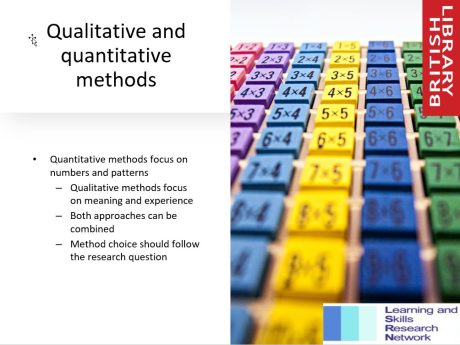
I put it plainly, “your method choice should follow the research question.”
That principle is liberating. It means you can begin with a question that genuinely matters in your setting, rather than forcing yourself into a method you do not yet feel confident using.
As I explained, “quantitative methods focus on numbers and patterns, and qualitative methods focus on meaning experience.” Most importantly, “both approaches can be combined.”
In FE, that combination is often essential. We track attendance, outcomes, retention, progress. But we also deal in motivation, identity, confidence, shame, joy, belonging. Mixed methods allow us to see both the pattern and the pulse.
3. Teacher voice is not decoration, it is data
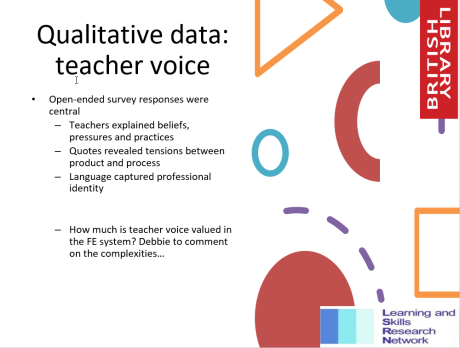
At one point I said, “careful listening to participant voices matters.” I wanted to emphasise that a well chosen quote can illuminate a system more sharply than a whole page of abstract commentary.
In the workshop I shared examples from a small scale study I carried out with Tom Dobson, where we surveyed teachers about creative writing and redrafting. I explained that a small dataset can still be revealing. I also modelled how you can treat a quote as evidence rather than anecdote, for example, “children are being taught to paraphrase, not write creatively.” That sentence is not a moan. It is a diagnostic statement, pointing towards policy pressure, assessment culture, and what gets rewarded.
Debbie picked up something equally important, the relationship between redrafting, feedback, and motivation. She spoke about how “feedback lands and how it feels”, and noted that redrafting is “quite complex” because it involves confidence, trust, and the skill of knowing what to change.
In FE, teacher voice is often pushed into the category of complaint, or sidelined as “subjective”. Small scale research can reframe it as knowledge.
4. Ethics are the heart of this work, because it is about relationships
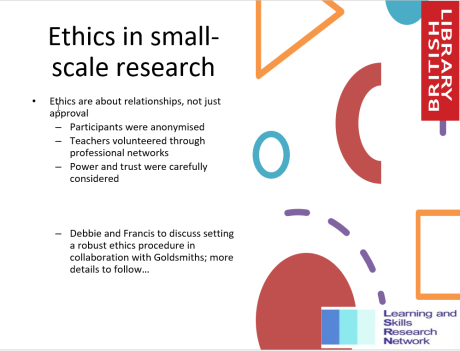
I told the group, “ethics are the centre of this kind of small scale research.” I also said something I believe strongly, “ethics are about relationships, not just about approval.”
In FE, that is not theoretical. It is daily reality. We teach young people, adults returning to education, people living with stress, instability, vulnerability, and also enormous resilience. Research in that context must be careful.
I explained that action research, at its best, is not extractive. It is collaborative. I described it as “problem solving, often in collaboration with the people we’re researching with”, and “a very ethical thing to be doing… it’s not extractive.”
C. asked a practical question that many FE colleagues will recognise, how do you develop an ethical process in a college without a formal ethics board? My answer, in brief, is that this is where networks matter. If colleges do not have robust structures, then professional communities can help create light touch, sensible, proportionate procedures, based on principles such as consent, anonymity, and minimising risk.
5. Research is about empowerment, and it helps you stay sane in accountability cultures
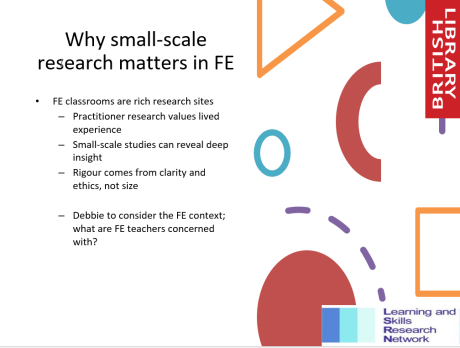
One thread running through the session was the pressure teachers and lecturers feel from accountability measures, inspection cultures, and performative demands.
I named the wider purpose directly, “this is about empowerment and about valuing your own lived experience.”
I also offered a practical definition of reflexivity that does not need to be wrapped in jargon. Research helps you become “reflexive and reflective”, meaning you can “step outside yourself… looking yourself in the field”, and also “look back at your own experience.”
This matters because without reflective space, FE can become survival mode. You rush, you patch, you deliver, you comply. Small scale research gives you a way to pause, notice, and name what is happening, not in order to complain, but in order to understand.
A brief note on the disruption
Part way through the session, we had an odd interruption. It felt slightly mysterious at first, a couple of young men deciding to indulge in high jinx, trying to throw the session off course with nonsense and threats.
Debbie handled it firmly, politely reminding everyone that we were “a group of adults trying to learn together”, and asking for “a bit of respect.” I paused the session, asked for support, and we disabled the camera and microphone. Then we carried on.
I joked later that I’m “not unfamiliar with hijinks”, which is true. Anyone who has taught for long enough has lived through disruption, both minor and extreme. But the moment mattered, because it sharpened one of the central points of the session. Research is not only about methods. It is also about creating conditions where learning can happen, where voices can be heard, and where a community of practice can protect itself, calmly, without drama.
The disruption also reminded me why FE matters. FE is often on the receiving end of public cynicism, institutional neglect, and sometimes outright contempt. Yet the teachers, trainers, and researchers in that room were serious, curious, generous people, thinking carefully about ethics, evidence, and impact. That contrast tells its own story.