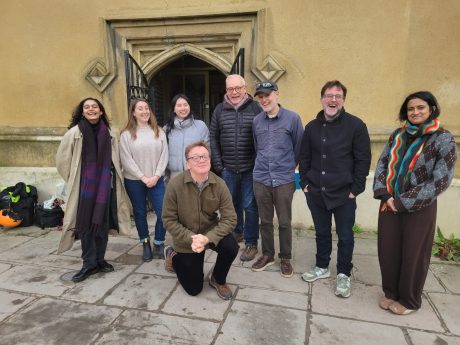
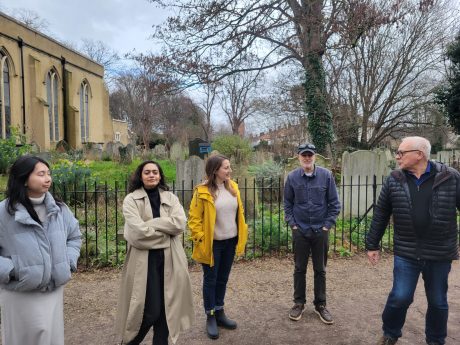
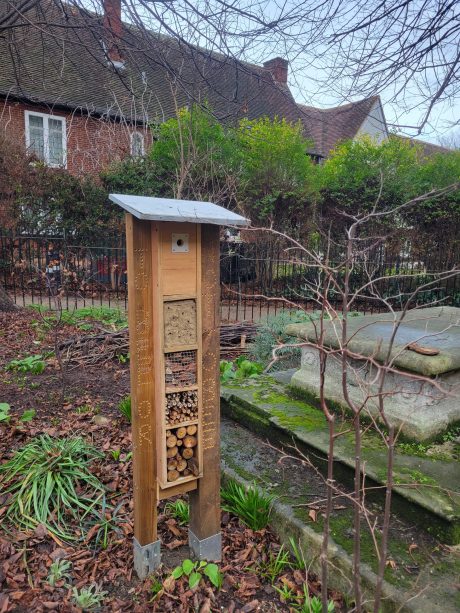
A few years ago St Mary’s Church, Walthamstow, in north east London was carefully and beautifully restored. Today it is an extraordinary community hub, with a welcoming cafe, an active programme of events, and award winning gardens, named Best London Churchyard in Bloom 2023. It is full of creative gardening ideas, such as the chance for volunteers to adopt a grave plot and tend it as a mini garden. The churchyard is cared for by Head Gardener Tim Hewitt, working alongside volunteers who do far more than garden. They also sculpt, make, chat, laugh, and return week after week to tend this shared place.
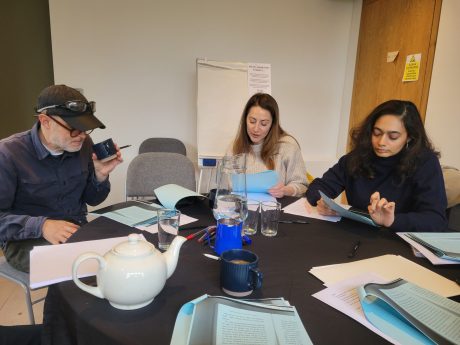
On Friday 23 January, we gathered there for an afternoon of creative writing with students from the MA Creative Writing and Education at Goldsmiths, which I lead as Dr Francis Gilbert. Tim and I have been friends since we were eleven, we went to school together, and our history was quietly present in the writing, because place is never just place, it is memory and relationship.
The session was led by two MA students, Sophie and Priyanka, whose different styles created a productive rhythm. Sophie began with reading-based prompts and open invitations that produced reflective pieces based on memories. Priyanka followed with structured, procedural prompts that produced bold writing very quickly. What emerged was a model for community creative writing that felt genuinely inclusive, playful, and serious at once.
Here are six practical ways this session showed how local communities can be engaged through creative writing.
1. Begin with the senses, and trust smell to unlock story
Sophie opened with by reading an extract 13 Ways to Smell a Tree by David Haskell, foregrounding smell and some lovely descriptions of conkers – “a waft of apple core and fruity chewing gum, moist and sweet”. The prompts were intentionally simple, write what you can smell right now, notice what it evokes; and/or write about a time when a smell brought back a strong memory; and/or begin a story or poem with a smell.
That simplicity was powerful because it did not require confidence or technique, it required attention.
I wrote about cycling from my home in Crouch End to Walthamstow, a memory trigger ride across London, with the smells changing as I crossed the city, the greener, sharper air around Finsbury Park, then the woody dampness and leaf mould smell as I arrived at St Mary’s. The writing brought back being a child here, and being at school with Tim. I recalled getting hit in the eye with a conker flung by another pupil (not Tim), which turned into a major medical emergency: I had to have an operation on my eye, with the splinters from the conker being pulled out of my eyeball!
Other participants followed smell into personal histories. One volunteer wrote strikingly about working as a young boy in a greengrocer’s shop that has vanished from the high street, the pungent smell of bananas as they were unsealed from the plastic bags they were shipped across the seas: the acridity of rotten potatoes; and the old fashioned containers the fruit and veg was held in. A community exercise does not need to be grand, it needs to be sensory enough to carry people into what they already hold.
2. Let weather and the natural world open big ideas, the Sublime, the real
Sophie’s next prompt moved to wind; she read a section from Amy Liptrot’s The Outrun, a terrific memoir about alcoholism, cold water swimming and the unique nature of the Orkneys. In the discussion, we touched on literature and lived experience, and on how city life can make us forget the force of weather until it interrupts us. After completing some writing on the theme of the wind in our lives, someone talked about their writing which focused upon Lundy Island in the Bristol Channel. This is a place where the wind is not just atmosphere, it is logistics, it stops boats, it delays helicopters, it makes a lighthouse ring like a bell, it brings horizontal rain that can keep you indoors.
Then another piece of writing took us elsewhere, to typhoons in Hong Kong, and what it felt like as a child. Tape crossed on windows, old movies on TV, ice cream eaten while the storm gathered, the excited feeling of finally getting attention from adults worried for everyone’s safety, then the moral shock of recognising the unequal world outside, shanty dwellers knee deep in mud and sewage, electrical fires, people dead, while “colonialists’ carpets are clean”. The writing arrived at a bleak, true line, that in the end “all that will be left is the wind”.
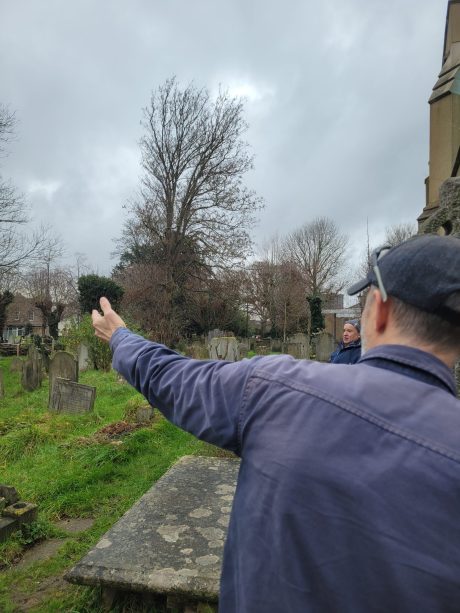
That conversation fed into what we then named explicitly, the power of nature, the Sublime, the universal world of matter we will all return to. A walk around the churchyard had reinforced this before we came to do the workshop. In previous sessions at the church, volunteers had made clay sculptures, and in the clay there were small fragments of bone, reminders that this ground holds a long continuity of life and death. The writing did not become morbid, it became more awake.
3. Warm up quickly with a micro prompt, and make laughter part of the method
Priyanka began her workshop by saying she wanted to “warm up” with a one-minute activity, a variation on a found poem. The prompt asked for one association for each category, something old, something cold, something loud, something green, then to add sentence starters that stitched the fragments into a surprising poem.
The results were immediate and funny, and that mattered. Someone read, “I am rusty”, followed by an unexpected football sound, then with the prompt being I am green, they wrote: “I am suddenly a leprechaun’s hat”; another person with this prompt was a “salvia leaf”. Someone else offered with the prompt about being cold, “I am school railings”, another “I am hands on glass”; with sounds, “I am a dog’s bark”. Another wrote, “I am a wooden spoon stolen from my mother”, and Priyanka’s response was exactly right, give it line breaks and you have a poem.
This is a key community practice, quick success lowers the stakes. It communicates, you can do this, you are already doing it, you do not need permission.
4. Use a strong shared text, then talk about what it does to the room
Priyanka read Mary Oliver’s poem The Gardener, which asks a chain of vast questions, have I lived enough, have I loved enough, have I considered right action enough, then admits, “I probably think too much”, before stepping into the garden where a “simple man” tends roses.
The discussion was far from academic. It was grounded, relational, and comic. There was laughter when a volunteer said playfully, “You are a simple man, aren’t you Tim?”. Tim replied: “Of course, I am, I am!” in his inimitable, self-effacing, ironic fashion.
At this juncture, Priyanka offered a framing that felt central to the whole afternoon. She noted that the poem asks huge, complicated questions, then turns toward smallness, toward something simple that can change you. As she pointed out, the natural world can feel vast and complex, but if you go further into it, it becomes smaller and smaller, and you can focus, and let it move you. In a community context, that shift is everything, an appositely chosen poem like Oliver’s invites reflection without lecturing, it gives people permission to be ordinary and profound in the same breath.
5. Make space for discomfort, and explicitly unteach self editing
Several prompts invited people into difficult emotional territory without demanding disclosure. Priyanka asked participants to list words for familiar and unfamiliar, then write about a time they felt like an outsider, holding the natural world in mind, while writing in a stream of consciousness way. Afterwards she did not ask for content, she asked about the experience of writing, whether people felt inside the memory or outside it.
Someone said they were in and out, but not deeply traumatised. Someone said writing lists about times when they felt they were outsiders was useful, another said they did not list anything at all, but the process of exploring a time when they felt an outsider still worked. Someone observed that familiar and unfamiliar can be the same thing, like a beloved cosy world that can also make you feel gauche, outsiderish, not classy enough. Another voice named what makes this hard, it’s “quite personal, isn’t it?”
After the volunteers were invited to list what they loved and hated in life/nature, there came a brilliant teaching moment. Someone said they kept fighting cliché, with a voice inside them thinking, “I can’t write that”. Priyanka responded by naming the problem; self-editing and self-criticism is learned; we’re taught to censor ourselves as we grow older. Meanwhile, writing sometimes requires mess, and to move feelings of self-hatred through something. She made writing feel practical and freeing; you do not have to be proud of it, you do not have to share it, you can burn it afterwards if you want.
That is the sort of permission community writing needs. It creates safety, not by removing intensity, but by removing the demand to perform.
6. End with imaginative embodiment, and let ecology arrive through voice
The later prompts given by Priyanka shifted into ecological imagination without preaching. Participants were asked to write about something beautiful in nature or life that annoys you, or something that annoys others but you love. The sharing here was joyous and various.
One participant wrote a rich sensory evocation of Greek music, hated by others but loved by them: their thoughts/memories were full of taste and texture: undrinkable retsina, feta and watermelon, a taverna floor warm underfoot, the sea turning liquid mercury against a pink green sky, the body becoming “monk seal” underwater. Priyanka praised the sensory detail, particularly how breath and memory carried the writing.
Another participant wrote about mosquitoes as “exquisitely engineered”, almost weightless, impossibly capable, and terrifying, with a hypodermic insertion that causes no sensation, and the group found themselves discussing beauty, machinery, evolution, and emotion, and how technical language can still feel deeply moving.
Another wrote about roses, using Fitzgerald’s image of Gatsby in his pool noticing how grotesque a rose can be, then moving toward the question, are roses a good metaphor for love, centuries of poets say yes, but “maybe gardeners are not the best people to ask”. It was funny and sharp, and it belonged exactly where we were sitting, in a garden.
Then Priyanka set the final prompt, and it was a masterstroke. Do not write a letter to nature, write a letter as nature, begin with “I am”. People chose water again and again. One person began, “I am life, I am death”, then flood, then avalanche, and spoke of being stuck but sensing possibility. Another produced a fierce ecological voice, water entering bodies, wrapping earth, warning humans about poisoning and wasting, asking what “transparent monstrosities” lie undiscovered in human depths. Another wrote a more companionable water voice, full of preferences and irritation, it did not like the filth pumped from boats, it liked coves, and the colour spectrum.
Tim’s contribution was both hilarious and tender, a love letter voiced to the earth, which was comic, ‘I love you earth’ etc, slightly “creepy” as someone called it, and full of feeling, ending with “lots of love from Tim”. The room laughed hard, but it was affectionate laughter, the kind that says, we are together.
This is where community writing becomes more than an activity. It becomes a shared practice of attention, voice, relationship, and care.
St Mary’s Churchyard is an ideal place for this because it is already a living commons. People volunteer, garden, sculpt, drink coffee, talk, return. The writing session simply tuned that existing community life into language.
If you want to run something similar, you do not need a grand project. You need a welcoming place, a handful of prompts, a shared text, permission not to perform, and time to walk slowly and notice what is already here.