
Warning: this piece contains plot spoilers.
Preface
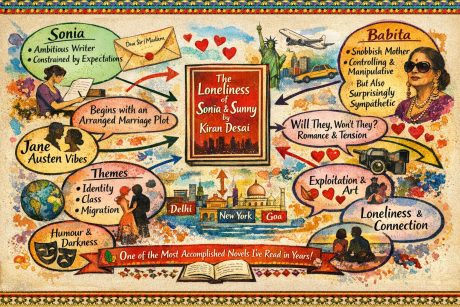
The Loneliness of Sonia and Sunny (2025) by Kiran Desai begins, disarmingly, like a comedy of manners. The inciting incident is simple and rather funny: Sonia’s parents, worried that their talented, independent daughter is not married, write to suggest a match with Sunny, a young man they know of through family connections. The story of the letter Sonia’s parents come to write to his mother, Babita, seeking the match and the social manoeuvring around it, gives the novel an almost Jane Austen quality at the outset, although this ironic mood soon shifts into something darker and richer. However, such is the skill of Desai that the ironic voice is never quite lost.
Sunny, on paper, seems ideal. He is educated, living in New York, working as a journalist after graduating from Columbia. But his life is already complicated. He has gone to America partly to escape his mother, the aforementioned Babita, a formidable, status-conscious figure long embedded in Delhi society. Babita, recently widowed, her husband an honest and decent man very unlike her, is both fiercely devoted to her son and deeply controlling. She views the proposed match with Sonia through the lens of class, reputation and ambition, and her snobbery is immediate and often very funny.
Sonia, meanwhile, has been studying in Vermont and moves to New York, hoping to become a writer, while entangled in a relationship with an older artist that begins to go wrong. The proposed match lingers in the background until Sonia and Sunny finally meet by chance on a train in India, and from that point a tentative, uneven romance develops.
The novel unfolds between India and the United States, moving across the late 1990s and early 2000s, and grows from this almost Austen-like beginning into a much larger exploration of love, family, migration and belonging.
What follows is a personal response to the novel, organised around seven things I learnt from reading it.
1. Great novels do not just tell a story, they make a whole world you can smell, fear and inhabit
The first thing I learnt from reading Kiran Desai’s The Loneliness of Sonia and Sunny is that a truly great novel does not rush to prove itself. It does not arrive announcing its themes, or nudging you to admire its seriousness. It trusts its material, and it trusts the reader. This novel is long, nearly 700 pages, and famously took years to write, but that long gestation shows in the best possible way. It feels not overworked, but deeply lived with. There is a difference. Some large novels feel swollen by their own sense of importance. This one feels earned.
A lot of the reviews pick up on this largeness. Alex Clark in The Guardian describes it as a “dazzling epic”, which seems right to me, though what I admired most was not simply the scale, but the control. Publishers Weekly stresses its elegance, and the Booker material highlights its ambition and historical depth, which also seems fair enough (Clark, 2025; Publishers Weekly, 2025a; The Booker Prizes, 2025a). But what stayed with me most was the sensual authority of the writing. Desai can make a place breathe. Delhi, Goa, New York, New England, Mexico, Venice, none of these settings feels ornamental. They arrive thick with pressure, smell, class, weather, dread, longing. In a lesser novel such range might have felt dutiful, or faintly showy. Here it never does. The movement across the world grows naturally out of the divided, restless lives of the characters. It is not global fiction putting on a performance of global fiction. It is a deeply felt novel about people who are not quite at home anywhere (Clark, 2025; Penguin Random House, n.d.; The Booker Prizes, 2025b).
And nowhere is that more obvious than in the extraordinary treatment of Babita and the Goa house she moves to after a traumatic series of events in her former home in Delhi. Babita begins almost as a Dickensian grotesque, monstrous, snobbish, selfish, manipulative, controlling, absurdly demanding, the kind of mother who seems capable of swallowing her son whole. Yet Desai does something remarkable with her. She does not flatten her into satire. She allows her to develop. By the end of the novel Babita has become, not lovable exactly, but deeply sympathetic. That, to my mind, is one of Desai’s greatest achievements. She takes what could have remained a cartoon of Indian maternal tyranny and turns it into a haunted, damaged, ageing woman, shaped by grief, by the death of her brothers, by the disappointment and sadness of her marriage, and by an almost pathological obsession with Sunny, who is at once her child, her project and her emotional refuge.
Her move from Delhi to Goa is one of the book’s great imaginative strokes. The house there in Goa feels genuinely haunted, by the family past, by colonialism, by class aspiration, by decay, by the unfinished business of property itself. Desai is brilliant on land ownership and property ownership, on the way houses do not simply shelter identity but generate it. People in this novel do not just live in houses, they are made by them, trapped by them, measured by them, and sometimes destroyed by them. Babita’s house in Goa becomes an extension of her psyche, and of India’s layered past too. That is one reason the novel feels so complete. Its moral and emotional world is inseparable from its material world.
2. Kiran Desai is one of the very few writers who can write men and women with equal truthfulness
A second thing I learnt is how rare it still is to find a novelist who can write men and women equally well. I mean not just competently, but with real inwardness, real authority, real feeling for their contradictions. Sonia and Sunny are not simply paired protagonists set up to illustrate some neat thesis about India and America, or tradition and modernity, or love and loneliness. They are more alive than that. Both are flawed, often selfish, often blind, often touching. Desai does not sentimentalise Sonia, and she does not reduce Sunny to a type. She lets both of them be inconsistent, ridiculous, wounded and recognisable.
Sunny is, for me, one of the great strengths of the book. He is selfish, yes, and emotionally stunted, often absurdly so, but he is also completely convincing. He is Babita’s son, and one feels the damage of that almost in his bloodstream. He has been raised in privilege, protected and over-shaped by class performance, aspiration and taste. He has Western reference points, a Western diet, Western longings, Westernised habits of mind, but he is not truly at ease in the West. When he gets to New York to work as a journalist in a press agency, he is not liberated. He is estranged. Even his relationship there founders partly because he cannot quite cope with the forms of privilege around him, especially the kind so deeply embedded in American culture that those who possess it barely register it, and because structural racism sits everywhere in the background, shaping experience whether acknowledged or not.
Yet India is not simply home either. Other reviews noticed this too. Clark picks up on his sense of being caught between India and New York, while Publishers Weekly also stresses his suspension between worlds (Clark, 2025; Publishers Weekly, 2025a). But what I think Desai gets exactly right is the emotional texture of that in-betweenness. It is not glamorous. It is debilitating. Sunny is not a romantic exile. He is a man formed by contradiction.
Sonia is equally well drawn, though very differently. She is talented, perceptive and serious, but continually hemmed in by structures that want to make use of her rather than let her become herself. She is not short of intelligence. She is short of room — a true room of one’s own. That distinction matters. The publicity around the book rightly stresses her ambition as a writer, and reviewers have also noticed how vulnerable she is, emotionally and artistically (Penguin, 2025; Publishers Weekly, 2025a; Kirkus Reviews, 2025a). But what struck me was how acutely Desai understands the burden of being a woman whose gifts are constantly being translated into expectations. Sonia is meant to be beautiful, available, marriageable, emotionally serviceable. Her sensitivity is her power, but it is also the thing that exposes her to harm.
3. Privilege can be not just a protection, but a kind of prison
A third thing I learnt is that Desai is brilliant on the deformations produced by privilege. Sunny is not a straightforward victim, and the novel would be much weaker if he were. He benefits from class, from wealth, from family networks, from inherited assumptions about what sort of life is possible. But Desai is too intelligent to leave it there. She shows how privilege can produce fragility, vagueness, even helplessness. It can leave someone curiously unequipped for reality because so much has been filtered, softened or pre-arranged for them.
And again, Babita matters here. She is not just an overbearing mother in the background. She is one of the mechanisms through which privilege reproduces itself. She creates an atmosphere of entitlement, snobbery, control and emotional dependency, and yet Desai is far too subtle simply to blame her. By the end of the novel, Babita herself looks like a product of class performance, thwarted desire and grief. Her obsession with Sunny is dreadful, but it is also pitiable. She clings to him because so much else in her life has been lost, emptied out, or exposed as illusion. Her monstrousness turns out to have history inside it.
A number of reviewers describe Sunny chiefly in terms of displacement, and that is certainly part of the story. But I think the novel goes further than that. It suggests that globalisation does not just create mobile subjects, it creates inwardly disoriented ones. Sunny belongs to a class that can imagine the world as open to it, but that does not mean it can move through that world with coherence or self-knowledge. The Guardian review talks about the emotional toll of repeated reinvention, and the publisher material also frames the novel through country, class, race and history (Clark, 2025; Penguin Random House, n.d.; The Booker Prizes, 2025b). Sunny embodies all of that. He is not alienated in New York merely because he is Indian. He is alienated because the version of privilege that formed him was already full of internal contradiction.
That is where the novel’s handling of race and culture becomes especially sharp. It refuses easy oppositions. This is not a simple East versus West novel. Desai is much too subtle for that. What she shows instead are people made by overlapping fantasies of elsewhere. Sunny wants the West, but what he finds there is not freedom, but an intensified encounter with his own uncertainty. The self does not dissolve in migration. It becomes harder to ignore. That, to me, is one of the reasons the book feels so contemporary, despite being set largely around the late 1990s and early 2000s. It understands the sadness built into cosmopolitan aspiration (Publishers Weekly, 2025b; Kirkus Reviews, 2025b).
4. Women are often trapped by patriarchy and its discourses of beauty, family mythology and the demand to be useful
Sonia’s story taught me something more painful. It shows how often a woman’s talent is subordinated to the uses other people have for her. Sonia is not simply constrained by a vague social atmosphere. She is boxed in by specific, accumulating pressures: the expectation of marriage, the currency of beauty, the threat of sexual danger, the emotional needs of her parents, the constant demand that she make herself useful. She is required to be many things at once: daughter, comforter, object of desire, muse, possible wife. These roles crowd in on her, limiting her sense of self. Desai maps this with extraordinary tact and precision.
Her family is central to this entrapment. Sonia’s mother is wonderfully, maddeningly drawn: ridiculous, selfish, damaged, spiritually vain, and yet never reduced to caricature. Part of what sustains her mother’s sense of self is a family myth inherited from her own father, Sonia’s grandfather. He was a German man who believed he had bestowed a kind of mystical inheritance on the family before disappearing into the wilds of Nepal decades earlier. This story hovers over the family like a legend, giving Sonia’s mother an air of spiritual significance she clings to. But Desai refuses to let that aura redeem her. Instead, it becomes another form of distortion.
What Sonia inherits from this lineage is not freedom but burden. The grandfather’s disappearance, and the mythologising of it, feeds a culture of emotional instability that is dressed up as depth. Her mother uses this inherited narrative to justify her own erratic, self-absorbed behaviour. Sonia, in turn, is left to carry the weight of it, expected to absorb and stabilise the emotional chaos around her.
Sonia’s father is one of the novel’s most impressive achievements. He is controlling and imprisoning, yes, but also loving, thoughtful, and at times deeply moving. Desai allows these contradictions to coexist. The handling of his cancer is particularly strong because it avoids easy solemnity. It is often funny, sometimes grimly so, but never cruel. Again, contradiction is allowed to stand.
Not all reviews dwell on these family dynamics, but several note Desai’s skill with secondary figures. The Guardian’s round-up praises the force of even marginal characters, and Penguin Random House’s summary of responses also emphasises the richness of the wider cast. That seems exactly right. Sonia’s parents are not background detail. They form the emotional and ideological structure she is trying, and often failing, to escape.
5. The novel is devastating about artistic exploitation
One of the sharpest things I learnt from the novel is how clearly Desai understands the predatory side of artistic culture. Sonia’s involvement with Ifan is not just a bad relationship, or a cautionary tale about a difficult man. It is a study of exploitation. He turns his own artistic intensity into a sort of moral permission. He uses Sonia as muse, as material, as emotional fuel. What is so well observed is that this kind of exploitation does not initially present itself as exploitation. It presents itself as permission, as excitement, as a larger life, as art.
That matters because The Loneliness of Sonia and Sunny is also, among other things, a novel about writing, art, journalism and the stories people tell themselves about seriousness. The Kirkus interview with Desai makes clear that these questions matter to the book. Sunny worries away at journalism, nonfiction and the instability of “truth” in news, while Sonia is linked more directly to fiction and artistic making (Kirkus Reviews, 2025b). None of this feels decorative. It is at the heart of the novel. Sonia’s relationship with Ifan shows what can happen when artistic ambition and emotional hunger meet power that is fundamentally exploitative.
If anything, I think some reviews underplay just how brutal Sonia’s predicament is. There has been a lot of deserved praise for the novel’s scale and thematic ambition, but one of its deepest strengths lies in its understanding of coercion, especially coercion disguised as intimacy or artistic necessity. Sonia is sexually assaulted a number of times, by both lovers and strangers. She is trapped by beauty. She is aestheticised and used. Yet Desai never reduces her to an emblem of victimhood. That is part of what gives the novel its force. It understands that exploitation is often woven into desire, admiration and self-deception. It also understands, crucially, that love is not the same thing as possession.
6. Desai writes about race, globalisation and cultural performance without sounding programmatic
Another thing I learnt is how difficult it is to write intelligently about race and globalisation without the novel becoming stiff with its own ideas. That is a common danger in the contemporary transnational novel. It starts to feel like a seminar in motion. Desai avoids that completely. Her ideas arrive through shame, longing, status anxiety, bodily unease, failed intimacy and the awkwardness of trying to become legible in different places. That is why the book feels alive. The thought is there, but it has been dramatised.
The reviewers have all touched on this in one form or another. The Guardian stresses postcolonial identity and the pressure of self-reinvention. Publishers Weekly presents it as a global love story. The Booker material emphasises the social and historical burdens people carry (Clark, 2025; Publishers Weekly, 2025b; The Booker Prizes, 2025b). I agree with all of that, but I would add that Desai is especially perceptive about cultural performance. Both Sonia and Sunny are trying to negotiate how they will be read by others. Sunny is shaped by Western tastes, but not accepted into Western ease. Sonia imagines America as release, but finds herself trapped there too, by love, by fantasy, by Ifan, by the same old structures appearing in new forms.
And again, property and ownership hover behind this. The novel understands that culture is never abstract. It is embedded in houses, inheritance, neighbourhoods, land, in who gets to own what and who is left merely passing through. Goa in particular becomes a place where colonial residue, class aspiration and emotional haunting all meet. That is one of the reasons the book’s commentary on identity feels so grounded. It is not merely theoretical. It is attached to walls, rooms, deeds, absences, possessions.
As a non-Indian reader, I was aware too of something faintly voyeuristic in the experience of reading the book. You do feel, at times, that you are peering into the innermost world of Indian middle class life, its insecurities, cruelties, aspirations and performances. But Desai is too good to let the reader settle into comfortable spectatorship. Looking is part of the book’s subject. Sonia is looked at, used, desired, stylised. Sunny looks at America and is judged by it in return. India itself is looked at through all sorts of fantasies. The novel understands that culture is never innocent of spectacle.
7. At its heart, this immense novel is about the possibility of rescue without sentimentality
The last and perhaps most important thing I learnt is that, for all its scale and darkness, this is finally a very human novel about the possibility of change. I do not mean redemption in a sugary or consoling sense. There is nothing neat about it. No false uplift. No sentimental tying up of loose ends. What Desai offers instead is something harder and more convincing: the possibility that damaged people might move, haltingly and painfully, towards a more truthful relation to themselves and to others.
A number of reviewers stress the sheer achievement of the book. Kirkus calls it a masterpiece, The Guardian keeps returning to its largeness and intricacy, and the publisher’s round-up quotes other outlets describing it in very exalted terms (Kirkus Reviews, 2025a; The Guardian, 2025; Penguin Random House, 2025.). That praise does not seem overblown to me. But what makes the novel exceptional, in my view, is not simply its scope. It is the feeling inside the scope. It gathers characters, humiliations, illnesses, violences, absurdities, landscapes, lusts, family ghosts and historical tensions until they begin to throw light on one another. There is loneliness everywhere in this novel, but there is also a stubborn longing for connection, and perhaps even for grace.
Babita is part of that too. Her evolution is crucial to the moral shape of the book. Desai does not excuse her, but she does humanise her. By the end, Babita has become one of those rare characters who force us to acknowledge how cruelty, grief, snobbery, loneliness and longing can coexist within the same person. That refusal to simplify her is part of what makes the novel feel so mature. It does not divide the world into monsters and victims. It shows how people are made, warped, haunted, and sometimes, despite everything, half changed by what they endure.
That is why it lingers. It is big, yes, but never bloated. It is clever, but never merely clever. It is wise without becoming smug. Above all, it is full of life in all its confusion and disappointment. You can see why it took so long to write. It has the density of something fully imagined and fully felt. For me, it confirms Kiran Desai as one of the most sophisticated novelists at work today, and this as one of the most accomplished novels I have read in a long time.
References
Clark, A. (2025) The Loneliness of Sonia and Sunny by Kiran Desai review – a dazzling epic. The Guardian, 9 September. Available at:
https://www.theguardian.com/books/2025/sep/09/the-loneliness-of-sonia-and-sunny-by-kiran-desai-review-a-dazzling-epic
Kirkus Reviews (2025a) The Loneliness of Sonia and Sunny. Available at:
https://www.kirkusreviews.com/book-reviews/kiran-desai/the-loneliness-of-sonia-and-sunny/
Kirkus Reviews (2025b) Kiran Desai Is (Hesitantly) Ready for Her Close-Up. Available at:
https://www.kirkusreviews.com/news-and-features/articles/kiran-desai-is-hesitantly-ready-for-her-close-up/
Penguin (2025) The Loneliness of Sonia and Sunny. Available at:
https://www.penguin.co.uk/books/471012/the-loneliness-of-sonia-and-sunny-by-desai-kiran/9780241770825
Penguin Random House (2025) The Loneliness of Sonia and Sunny by Kiran Desai. Available at:
https://www.penguinrandomhouse.com/books/212138/the-loneliness-of-sonia-and-sunny-by-kiran-desai/
Publishers Weekly (2025a) The Loneliness of Sonia and Sunny. Available at:
https://www.publishersweekly.com/9780307700155
Publishers Weekly (2025b) Kiran Desai’s Labor of Love. Available at:
https://www.publishersweekly.com/pw/by-topic/authors/profiles/article/98271-kiran-desai-s-labor-of-love.html
The Booker Prizes (2025a) The Loneliness of Sonia and Sunny. Available at:
https://thebookerprizes.com/the-booker-library/books/the-loneliness-of-sonia-and-sunny
The Booker Prizes (2025b) Everything you need to know about the Booker Prize 2025 shortlist. Available at:
https://thebookerprizes.com/the-booker-library/features/everything-you-need-to-know-about-the-booker-prize-2025-shortlist
The Guardian (2025) The Girlfriend to Jade: the week in rave reviews. Available at:
https://www.theguardian.com/culture/2025/sep/13/the-girlfriend-to-jade-the-week-in-rave-reviews