
Opinion

How Much Truth Is Enough? Reflecting on Raynor Winn’s Response to The Observer

In the wake of The Observer’s recent exposé and the resulting public fallout, Raynor Winn has published a detailed and impassioned defence of The Salt Path, and by extension, her entire literary persona. Her statement—poignant, clarifying, yet also emotionally fraught—deserves careful attention. But for those of us who care deeply about the ethics of memoir, her account raises important questions. Not about whether she and Moth were “really” homeless, but about what kind of truth memoirists owe their readers, and whether Winn’s defence inadvertently confirms some of the ethical complexities I explored in my earlier posts: Ten Ethical Complexities of Memoir, Thirteen Ways of Looking at The Salt Path, and Five Salty Lessons.

Let’s begin by acknowledging that Winn has been on the receiving end of vile abuse, including threats to her family. Nothing justifies that. The line between critique and cruelty must be defended. Winn’s books have moved many readers, including me; they have shed light on hidden experiences, especially of aging, disability, and economic vulnerability. But now, with the release of her personal statement, we are being invited to read the books again—through a clarifying lens. Some fog is lifting. And some new mist is rising.

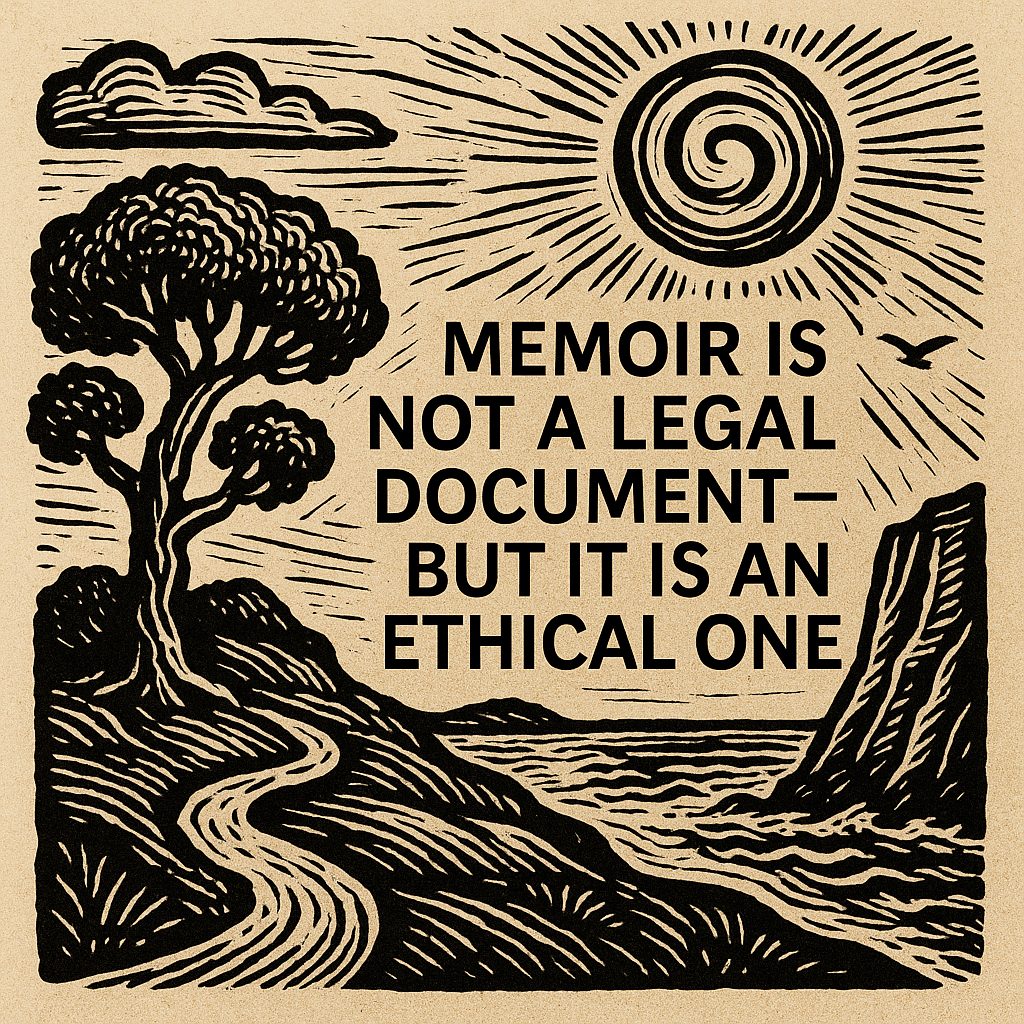
Memoir Is Not a Legal Document—But It Is an Ethical One

Winn’s central argument is that The Salt Path is a “capsule of time,” not a full account. That’s reasonable. All memoirs are selective. Yet the details now emerging about her past (an out-of-court settlement over embezzlement claims, a ruin in France, debts unpaid or misdirected) aren’t just omitted side stories. They cast retrospective shadows over the entire frame of the book. As I wrote in my earlier blogs, memoir invites a covenant of trust. Even if names are changed, and some things are left unsaid, the ethos of memoir relies on a shared sense that the bones of the story are real, and fairly presented.

What unsettles me most is not that Winn used pseudonyms (many writers do), or even that she restructured events for narrative cohesion. It’s that The Salt Path trades on a symbolic purity that now feels compromised: the righteous couple, wrongfully dispossessed, who find redemption through nature and love. When more complex truths emerge—of legal disputes, past mistakes, perhaps even self-misrepresentation—readers aren’t merely disappointed. They feel deceived.

The Moth Question

Winn’s detailed rebuttal of The Observer’s claims about Moth’s illness is clearly heartfelt. She provides excerpts from medical records (with Moth’s consent), explains the nature of CBS, and powerfully describes how the suggestion that Moth is “faking” has harmed him. This is persuasive and moving. It also raises a subtle question: if the narrative of recovery in The Salt Path is partly symbolic, partly miraculous, and partly literal, what are readers meant to believe?

Winn is adamant that she has never claimed walking “cured” Moth, but it’s also undeniable that the book’s appeal rests on a kind of secular miracle: that the act of walking—weather-beaten, elemental—restores vitality and dignity. This narrative has helped many readers. But now, confronted with medical complexity and terminological shifts (from CBD to CBS), readers might wonder whether the miracle was partly manufactured, not in bad faith, but under the pressures of storytelling.

The Problem of Memoir’s Silences

Some of the most troubling aspects of Raynor Winn’s response lie not in what she disputes, but in what she omits. Her account of the embezzlement allegation made by her former employer, Martin Hemmings, is notably vague. She refers only to “mistakes” made during a “pressured” time, without clarifying what those mistakes were. Although she admits to reaching a legal settlement and paying Hemmings on a “non-admissions basis,” she fails to disclose the sums involved—reportedly tens of thousands of pounds, according to The Observer (Hadjimatheou, 2025). Given that The Salt Path is structured around the idea of losing everything, this financial entanglement is highly relevant. Winn’s omission of both the nature of the allegation and the scale of the settlement leaves readers with a conspicuous narrative gap.

Instead, she carefully separates the Hemmings dispute from the financial events depicted in The Salt Path, insisting that it played no part in the loss of their home and that Hemmings was not the man fictionalised as “Cooper.” These statements may be legally accurate, but they sidestep a deeper narrative and ethical question: if this serious episode involved police investigation, reputational harm, and a substantial financial payout, why was it left out of a memoir that otherwise draws heavily on hardship and adversity for its emotional power?

Equally revealing is her lack of reflection on why this episode was excluded. Even if the book is, as Winn claims, a “capsule of time,” one would expect that such a pivotal, morally ambiguous moment in her recent past might at least be acknowledged as context. Did the experience shape her and Moth’s later vulnerability to “Cooper’s” high-interest loan? Did it affect their understanding of trust, risk, or responsibility? These questions remain unanswered. Instead, we are left with the impression of a narrative carefully pruned to fit a redemptive arc.

Then there is the French ruin—described now as uninhabitable and worthless. It may indeed be of little material value, but it was bought through remortgaging the family home and still constitutes a second property. In a story whose central claim is that the couple had “lost everything,” the existence of even a nominal asset undermines the clarity and emotional resonance of that phrase. It suggests not deceit, but a selective framing designed to reinforce a mythic sense of total dispossession.

In memoir, silence is never neutral. What the writer leaves out—especially when it serves to protect the narrator or simplify a morally messy situation—can shape the reader’s understanding as much as what is included. The power of The Salt Path lies in its appearance of moral clarity and elemental simplicity: nature heals, truth prevails, betrayal is external. But as Winn’s response inadvertently reveals, the real story is far more entangled, legally, ethically, and emotionally. And in those entanglements, some trust may quietly erode.

The Reader as Witness, Not Judge

None of this is to say that Winn set out to deceive. But The Salt Path, like all powerful memoirs, made a bold claim on readers’ sympathy, and in doing so, placed itself within a particular moral register. When that register is recalibrated, even slightly, the whole reading experience changes.

What’s needed now is not public shaming, but an open conversation about how memoir functions in our literary and social lives. Winn’s books are not meaningless because of these revelations. But their meaning has changed. They are now case studies in the complexity of narrative truth, the entanglements of fact and feeling, and the fraught territory where personal redemption stories meet commercial success.

A Call for Memoir 2.0?

Perhaps, in time, Winn might write a sequel: not just another path-walk, but a reflection on what it meant to become an icon, and then be questioned. Such a book could deepen, not diminish, her literary legacy. As I argued in The Mindful Creative Writing Teacher (Gilbert, 2024, p. 172), when writers reflect on their own storytelling processes, especially in memoir, they offer readers not just a life, but a lens.

That’s what I hope we all take from this difficult moment: not a rush to judgment, but a renewed attention to how truth is told, and what it costs.

References

Gilbert, F. (2025) The Mindful Creative Writing Teacher. London: FGI Publishing.
15 responses to “How Much Truth Is Enough? Reflecting on Raynor Winn’s Response to The Observer”


  1. Very good comments here! It is the apparent deceit that is causing concern amongst many readers, I think. They want to believe in the restorative power of walking in nature and now are not so sure! I bought the book for my wife and she loved it, but she feels that she has been misled in feeling hope thst is in Winn’s world where truth seemed to matter, but now feels its a lie! It has made me compare The Salt Path to Bruce Chatwin’s The Songlines – also a travel book, which is how I thought of Winn’s book. The Songlines has apparently quite a lot in it that is not true! Chatwin also claimed to have a rare disease which eventually killed him, but I seem to remember, it was actually AIDs. Also I thought of The Teachings of Don Juan by Carlos Castaneda -almost all the invention of the author. However, it may be that a lot of time has passed since these were published, but I don’t feel quite as misled and deceived by them as The Salt Path!

    Peter Mason

  2. Thank you Peter for this rich and thought-provoking comment. I’ve been reflecting especially on your comparisons with The Songlines and The Teachings of Don Juan, and I think you’ve highlighted something crucial about how different kinds of “truth” operate in these books — and how readers respond when those truths come under scrutiny.

    The Teachings of Don Juan, as you say, always had a fictional, almost hallucinatory quality. The accounts of altered states, out-of-body journeys, and shamanic visions pushed the narrative into the realm of the psychedelic, where the question of literal truth felt almost secondary. Castaneda’s work was influential, but the realisation that it was largely fabricated didn’t provoke the same personal sense of betrayal in many readers — perhaps because it always occupied that blurry boundary between anthropology, fiction, and spiritual allegory.

    With The Salt Path, the contract with the reader feels different. Winn’s voice is clear, humble, and rooted in hardship — it invites us to believe, to walk with her, to heal with her. So when aspects of that story are questioned, it shakes something deeper: the emotional compact between reader and writer.

    Your point about Bruce Chatwin is especially compelling. He was writing and living in the shadow of the AIDS crisis, married, and navigating a world rife with homophobia and misinformation. It’s true that he never presented himself as a kind of moralist or ascetic — his prose was sensuous, allusive, and elusive. Whether or not his illness was “relevant” to his writing is debatable, but as you suggest, had he spoken out more publicly, as someone like Derek Jarman did, it might have helped challenge stigma and bring AIDS out of the shadows. At the same time, we can’t ignore the social pressures that made such disclosure extremely difficult at the time, especially for someone working within elite cultural circles.

    All of this brings us back to the complexities of memoir, truth-telling, and the ethical responsibilities of the writer. When is omission understandable, even necessary? When does it become misleading? And how do we, as readers, respond when what we believed to be true turns out to be more constructed than we realised?

    Thank you again for opening up these lines of thought — I’ve really valued your contribution.

    Warm wishes,
    Francis

    francisgilbert

  3. Its nice to know my comments made you think, particularly as yours did for me!

    Although said as a joke by John Cleese, and I am paraphrasimg it, this seems somehow relevant “The despair I can cope with, its the hope I can’t handle!”
    Peter

    Peter Mason

  4. Good piece there Francis, thanks for sharing it.

    Philip Lynch

  5. There’s no getting around it – Sally Walker aka Raynor Winn – lied. She lied about losing their home, she lied about the debt, she lied about her husband Moth having a terminal illness. This isn’t a memoir that exaggerates the truth or compounds characters – this is a memoir that takes information they were given in 2015 – 2 years AFTER they purported to walk the south west coast past – that Moth exhibits symptoms of CBS which the medic describes as “mild” and backdates a more serious condition to a hike they likely didn’t even do. And the deceit doesn’t just readers who were duped, it kills a genre and in one case I know got a memoir turned down by publishers for not being “as dramatic as The Sale Path” – Raynor Winn and Moth should be locked up and the key thrown away (literally! – they were given a house by someone on the basis of pity after he read the book – bet he feels foolish now!) and Penguin should recoup the money. The only positive thing that might come out of this- Jason Sacks and Gillian Anderson now have a great follow up film to make – and it couldn’t be worse than that dreadful film

    Erica Manning

  6. If she writes a second memoir I won’t be reading it, not least because all the follow-up books to The Salt Path aren’t particularly good.

    I really loved The Salt Path when I read it in 2019. It’s clear that Moth is suffering from some form of the illness they discuss in the book, or something v similar, and I still find it an incredible achievement if they did indeed walk the entire SWC path.

    However, the back-drop to the walk, the embezzlement is highly problematic. If you watch interviews with Raynor, she sets the scene with a very carefully edited version of their life in Wales to ensure readers/viewers feel suitably sympathetic. I find it quite gross to be honest. She has manipulated her audience, and we have secured their millionaire lifestyle. I also felt the wording in her statement regarding the embezzlement, to lack true feeling. She calls it ‘mistakes’. I would prefer she just comes clean now; I would forgive that; I don’t think her words go far enough in taking genuine responsibility for her actions.

    With regard to the topic of homelessness; perhaps they have shed a light on the subject and maybe that is positive. However, you cannot honestly call yourself homeless when you own land in France.

    My personal view is that Raynor knew exactly what she was doing when she wrote about a ‘capsule of time’ and omitted key aspects of their lives.

    I sincerely hope Moth continues to thrive, and lives a long, happy life. But I won’t be funding any further ‘projects’ of theirs.

    Sarah Louise

  7. In a follow-up podcast, Chloe Hadjimatheou and the team involved in the Salt Path expose discuss their process, and their response to the fallout. One of the things that struck me very forcibly is a remark that in emphasising her own emotions and behaviours and responses to past circumstances, Mrs Winn/Walker has invalidated those of others who will have been impacted by her actions. Does it not occur to her what a devastating impact the loss of thousands of pounds and the efforts made to recover it had on the estate agent and his wife? The garage owner in North Wales who says she still owes him £800 – a not inconsiderable sum for a small town garage business. Chloe H says they are in the process of digging deeper, so this is clearly not the end of the story. And what of the Daily Mail report of a visit by tbeir reporter to the farm near Loswithiel that the Walkers rented from the entrepreneur who rented it to them? It’s now vacant, neighbours say they haven’t been sighted for a while, and the entrepreneur who is named was very unwilling to be involved. If someone opens up their life and marriage in three books to public scrutiny and discussion, they must surely expect there to be scrutiny that may reveal things they’d prefer kept quiet. But it’s the price one pays for royalties and film rights and tv interviews etc. Selective truth and silence will not now work.

    Kate King

  8. Here I am, still eating up every bit of commentary on the debacle that is “The Real Salt Path.” I don’t know what I’m hoping to find, but I’m left feeling confused about what to think and how to feel. I have read all of Winn’s books, not from a place of genuine empathy or respect for her writing, which is obviously good, but from a place of incredulity. My husband died of PSP, a sibling to CBD, and it is a manner of death by dismantlement so diabolical that I would not wish it on my worst enemy. When I got two-thirds into The Salt Path and began to pick up on the inference that endurance walking was somehow reversing Moth’s symptoms, I dug beneath the initial envy and thought, “good for him.” By the time I finished the third book, LANDLINES, I found myself hate reading. “When do we get to the part where we share the agony of what these progressive neurodegenerative diseases really do to people, when they come to terms with the untreatable, incurable nature of movement disorders? Surely, the acceptance stage is coming. It never came. I continued to check in via Instagram and Google, doomscrolling for evidence that this couple was experiencing the same trauma that I and my family had gone through. I am not proud of this. It felt wrong. It felt heartless. What kind of weak person needs to know total strangers are suffering? This new development resulted in full-on Schadenfreude. Then I read Winn’s statement, her emotional description of how being accused of lying about Moth’s illness has had devastating effects on her family, and I am guilty all over again. I don’t know what to believe. Miracles happen? Misdiagnosis happens? These people are extremely private, unlike me, who pasted sensitive details of my husband’s diminishment all over my Instagram because I wanted to raise awareness of rare diseases? I don’t want anyone to suffer. I also don’t want families dealing with these disorders to be fed false hope. Who should I be disappointed in? The authors, the publishers, the Observer journalist, or myself?


  9. Thank you for sharing this — your honesty cuts through so many of the oversimplified hot takes I’ve seen around The Real Salt Path and the recent revelations. I don’t think you’re alone in feeling confused, conflicted, even guilty. What you’ve described — the hunger for clarity, the ache for recognition of your reality within someone else’s narrative — is deeply human.

    It makes sense that you’d read Winn’s books searching for some reckoning with the brutal truth of PSP and related disorders. You lived it, and you watched someone you love be taken apart by it. To then encounter a story where that suffering seems softened, side-stepped, or possibly reversed is understandably maddening — not just emotionally but ethically.

    I think your instinct — to want no one to suffer, but also not to see suffering diminished or misrepresented — is the beating heart of this whole controversy. Whether there was a misdiagnosis, a miscommunication, or something else entirely, the lack of openness about it has left many readers, especially those with direct experience of neurodegenerative diseases, feeling blindsided.

    You asked who you should be disappointed in. Maybe the answer is: no one and everyone. The authors, for not addressing the ambiguity sooner. The publishers, for promoting a story that was always going to raise complicated expectations without enough editorial scepticism. The media, for pushing narratives of redemption without reckoning. And perhaps, if we’re brave enough, ourselves — not for wanting clarity or even for doomscrolling, but for being human in a world that so often offers us myth in place of truth.

    Your willingness to reflect on all this — publicly and generously — is a rare gift. It doesn’t provide simple answers, but it does offer solidarity. And that, perhaps, is something closer to what we really need.

    francisgilbert

  10. This is such an important point, and I appreciate you raising it. The podcast episode struck me too — particularly that idea of how emphasising one’s own emotional truth can, intentionally or not, invalidate the real harm experienced by others. There’s a moral tension at the heart of memoir writing, especially when public sympathy (and commercial success) rests so heavily on a redemptive narrative.

    The estate agent, the garage owner, the unnamed landlord — they represent the quieter, messier realities that don’t always fit neatly into the framework of literary metaphor or personal triumph. When those voices start surfacing, it reminds us that real lives — and real losses — are involved, not just symbolic ones.

    Of course, readers are not judges or juries, and memoir is never the whole truth. But the moment someone chooses to turn their life into a story, particularly one that trades on hardship and resilience, a kind of informal social contract is entered into: the reader trusts that what’s being shared is, at the very least, not wilfully misleading. When that trust starts to fray, the emotional and ethical stakes are high.

    I think you’re right: this likely isn’t the end of the story. And perhaps it shouldn’t be. What’s needed now is not pile-on or punishment, but openness, accountability, and, above all, a refusal to let poetic narrative erase the material consequences of past actions. Storytelling is powerful, but so is listening — especially to those who didn’t get to write the book.

    francisgilbert

  11. I really appreciate your honesty here — it echoes a lot of what many readers are feeling right now: betrayed, conflicted, disappointed. Especially when a book like The Salt Path felt so intimate and uplifting at first encounter, it’s unsettling to look back and realise how carefully curated that “capsule of time” really was.

    You’re right that Raynor Winn has written other memoirs — The Wild Silence and Landlines — and while many readers found them moving, others felt they lacked the emotional depth and grit that made The Salt Path resonate so powerfully. That sense of something being “edited for effect” only grows in retrospect, especially when crucial background information (like the embezzlement case, land ownership, and prior financial history) seems to have been deliberately omitted or minimised.

    At the same time, I find myself reflecting on how complicated memoir can be. Every memoir is a selective act — of memory, narrative, and emphasis. But when public funding (via book sales, film rights, interviews) enters the picture, the line between personal testimony and public accountability gets very thin. And I agree — calling fraud convictions “mistakes” feels emotionally evasive, especially for those who suffered directly.

    Still, I also find myself sitting with the contradiction: that The Salt Path did open conversations about homelessness, chronic illness, and resilience in ways that moved and motivated many people. That good work exists alongside the problematic omissions — not instead of them.

    Perhaps what’s needed now is something rarer: not just another book or statement, but genuine reckoning. Not a polished memoir, but a moment of real humility.

    And yes — most of all, I share your hope that Moth is doing well, and that whatever happens next, it involves a deeper kind of honesty than what we’ve been offered so far.

    francisgilbert

  12. “I think your instinct — to want no one to suffer, but also not to see suffering diminished or misrepresented — is the beating heart of this whole controversy. Whether there was a misdiagnosis, a miscommunication, or something else entirely, the lack of openness about it has left many readers, especially those with direct experience of neurodegenerative diseases, feeling blindsided.”

    Thank you for putting words to something that, for me, felt beyond description, mostly due to the emotions it called on.


  13. I am a German avid reader of nature writing, and I was tempted to buy the “salt path”, but never did because there were so many other books that I wanted to read first. Many people seem to think, everything is allowed, if the money is good. The majority of comments on the net don’t see any problem or scandal. For them, a memoir is fiction anyway, so what. I have come to the conclusion that events like this are part of the book publishing business and inevitable to occur again and again in the race for the next bestselling story. Perhaps it is not incidentally that the official magazine “Börsenblatt” of the association of German publishers and bookshops has not mentioned the salt path scandal yet, whereas the daily news are reporting since weeks. Sales of the book seem to continue meantime.

    Martin Stankewitz

  14. Dear Martin,

    Thank you for your thoughtful and insightful comment. As a fellow reader of nature writing and memoir, I appreciate the seriousness with which you approach these issues—and I share many of your concerns.

    You’re right that the controversy surrounding Raynor Winn’s The Salt Path raises important questions. Recent allegations, first reported in The Observer, suggest that significant facts were omitted or distorted in the memoir. These include a past conviction for embezzlement, the ownership of a second home in France during the time of her supposed homelessness, and questions around her husband Moth’s medical diagnosis. As the Associated Press and The Times have also noted, these revelations have ignited intense debate about truthfulness, marketing, and the ethics of memoir writing.

    Your observation that many readers online seem unbothered—seeing memoir as a form of fiction anyway—is a sharp one. This blurring of boundaries between truth and narrative has, unfortunately, become quite common. As you rightly suggest, the pressure to produce a compelling “bestselling story” can push writers and publishers into murky ethical waters. In this case, the emotional resonance of Winn’s story, and the powerful narrative of resilience it offers, may have overshadowed more rigorous fact-checking and accountability.

    What’s especially interesting is your point about the Börsenblatt—the official magazine of the German Publishers and Booksellers Association—remaining silent on the matter, even while the daily press in Germany and abroad has been covering the story for weeks. This silence perhaps reflects broader systemic issues: a reluctance within parts of the publishing industry to interrogate successful narratives too closely, especially when they’re still selling well.

    The ongoing success of The Salt Path—now a major film starring Gillian Anderson and Jason Isaacs—demonstrates how difficult it can be to reckon with these contradictions once a story has entered the public imagination.

    Ultimately, like you, I’ve come to believe that these incidents aren’t anomalies—they’re symptoms of a publishing culture increasingly driven by market logic. That doesn’t mean we should give up on truth in memoir. But it does mean we must read more critically, support more rigorous editorial standards, and demand greater transparency from publishers who claim to be selling us “true stories.”

    Thank you again for your honest and informed reflections. They help keep this conversation alive—and vital.

    Warm regards,
    Francis

    francisgilbert

  15. I enjoyed The Salt Path and was grateful for the fact it has people out walking and enjoying nature it was an inspirational and uplifting story, people make mistakes everyone does I don’t fully understand how bitter some people are over this or how judgmental they are,I could perhaps understand if one knew them personally but not so far removed from this story.I feel sorry for people who have been disappointed or feel injured but holding onto it is never soothing and it is a choice they are making and their responsibility .
    I hope healing comes to all parties

Leave a Reply

Your email address will not be published. Required fields are marked *


Related reading

Sign up for my mailing list

Get curated content!