
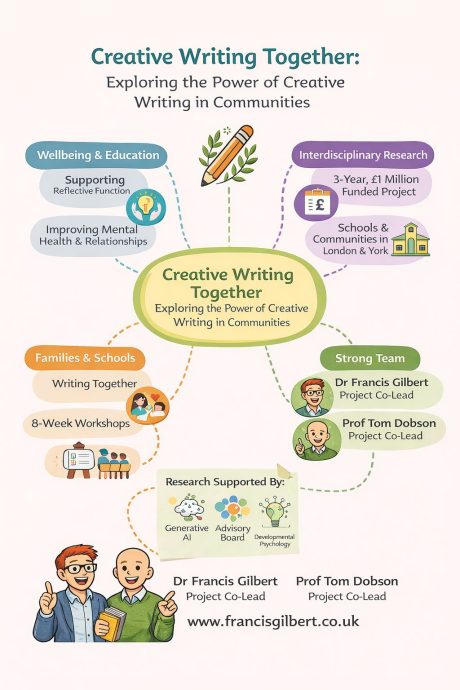
I am honoured to share that Professor Tom Dobson and I, alongside an extraordinary interdisciplinary team, have secured close to £1 million in research funding for a three year project exploring how creative writing can support children, parents, teachers and communities. The project, Creative Writing Together: Children, Parents and Teachers Developing Reflective Functioning through Creative Writing, represents a major investment in understanding how writing can transform relationships, learning and wellbeing across society.
This funding has been awarded because the research speaks directly to a profound social and educational challenge. Across the UK and internationally, families and schools are grappling with rising mental health concerns, increasing school absence and widening social inequalities. Research indicates that many parents experience ongoing mental health difficulties that can influence children’s development, while one in seven young people globally experiences a mental disorder, with disadvantage intensifying these experiences (WHO, 2021; Hogg and Moody, 2023; Mental Health Foundation, 2022, p.19). Our project responds to this context by positioning creative writing not as an optional enrichment activity, but as a powerful relational practice capable of fostering empathy, perspective taking and emotional understanding .
Why creative writing matters now
The central concept guiding the project is reflective functioning, the capacity to understand behaviour in terms of thoughts, feelings and intentions. Psychological research demonstrates that strong reflective functioning is associated with secure attachment, improved relationships and greater emotional regulation (Fonagy et al., 2016). Yet despite decades of research into wellbeing interventions, creative writing has rarely been examined as a preventative tool for developing reflective functioning across families and school communities.
Professor Dobson’s pioneering research into creative writing, identity and discourse analysis provides a vital foundation for this work. His studies have demonstrated how young writers construct identities through narrative and how collaborative writing practices can reshape classroom relationships (Dobson and Stephenson, 2017). My own research has focused on dialogic pedagogy, emotionally attuned feedback and reflective writing practices, including reciprocal approaches to redrafting and multimodal planning methods such as diagrarting, which support writers in integrating emotional and cognitive processes. Together, these strands of research led us to ask a bold question. What would happen if creative writing became a socially prescribed practice designed to support families and communities as well as individual learners.
A collaborative team of experts
The scale of this funding reflects the strength and breadth of the research team. Professor Tom Dobson leads the project as Principal Investigator, bringing extensive experience in creative writing pedagogy, co construction methodologies and international research leadership. I serve as Co Investigator, leading the London strand of the project and working closely with schools and community partners across South London .
We are supported by an outstanding interdisciplinary group. Dr Paige E. Davis contributes deep expertise in developmental psychology and reflective functioning, ensuring that the project’s evaluation methods are rigorous and ethically grounded. A teacher, who is also an expert in AI and Education, leads the integration of generative artificial intelligence across the programmes, examining both the opportunities and risks of AI for creative learning. Jane Collins, an early career researcher, and postgraduate research assistants in London and York support delivery, data collection and analysis, ensuring continuity across settings.
Beyond the core team, an advisory board made up of educators, community leaders and international scholars offers guidance throughout the project. These include Rob Newton from City of York Council, Clair Kitchen from Excel Learning Trust, Alice Player from Deptford Green School, and creative educators such as Danja Sanovic and Adam Gillett. Their involvement ensures that the research remains grounded in real world educational practice while maintaining strong links to policy, health services and creative industries .
A three year programme rooted in community and schools
Over the next three years we will deliver a series of eight week creative writing programmes in community centres and secondary schools in London and York. Families will write together, teachers will collaborate with students, and participants will explore storytelling as a way of understanding themselves and others. The programmes will involve more than 150 participants across multiple cycles, allowing us to examine both immediate and longer term impact .
The methodology combines action research with quantitative and qualitative analysis. Workshops will be followed by reflective team meetings, ethnographic observation and analysis of participants’ creative writing. Pre and post intervention questionnaires will measure changes in reflective functioning, emotional comprehension and behaviour, drawing on validated instruments such as the Reflective Functioning Questionnaire and the Strengths and Difficulties Questionnaire (Fonagy et al., 2016; Goodman, 1997). This mixed methods approach ensures that the research captures both statistical outcomes and the lived experiences of participants.
The project also engages critically with generative AI. Rather than treating AI as a threat to creativity, we are investigating how it can support inclusive writing practices, particularly for young people who may feel excluded from traditional literacy models. At the same time, we remain attentive to concerns about cognitive offloading and critical thinking (Gerlich, 2025). By embedding AI within reflective pedagogies, we hope to model responsible and creative uses of technology in education.
Why the project received major investment
One of the reasons this project attracted significant funding is its originality. While creative arts interventions have often focused on trauma or therapeutic contexts, there has been little research into preventative approaches that bring families, schools and communities together through writing (Barak and Leichtentritt, 2017). Our proposal offered a new ecological vision, one that recognises that children’s wellbeing emerges through relationships across home, school and community.
The project also builds on a decade of collaborative research between creative writing, education and psychology. Earlier pilot programmes demonstrated that when adults and children write together, new forms of dialogue emerge that can strengthen trust and mutual understanding (Dobson et al., 2024). This funding allows us to scale that work nationally, producing open access guides, academic articles and public learning events so that the findings can benefit educators and families far beyond the project itself.
Looking ahead
For me, this project represents a deep affirmation of the belief that writing is fundamentally relational. Creative writing is often imagined as a solitary activity, yet the research we are undertaking positions writing as a shared practice through which people learn to listen, imagine and empathise. In a time when education systems feel increasingly pressured and fragmented, the opportunity to explore writing as a space of connection feels both urgent and hopeful.
Over the next three years we will share updates, reflections and resources as the work unfolds. My hope is that Creative Writing Together will demonstrate that creative writing belongs not only in universities or literary spaces, but in classrooms, community centres and family conversations. If successful, the project has the potential to reshape how policymakers, educators and researchers understand the role of creativity in building healthier, more reflective societies.
References
Barak, A. and Leichtentritt, R., 2017. Creative writing after traumatic loss, towards a generative writing approach. British Journal of Social Work, 47(3), pp.936 to 954.
Bickerdike, L., Booth, A., Wilson, P. M., Farley, K. and Wright, K., 2017. Social prescribing, less rhetoric and more reality. BMJ Open, 7(4), e013384.
Dobson, T. and Stephenson, L., 2017. Primary pupils’ creative writing, enacting identities in a community of writers. Literacy, 51(3), pp.162 to 168.
Dobson, T., Curtis, A., Collins, J., Eckert, P. and Davis, P. E., 2024. Intergenerational spaces for co creating creative writing, developing reflective functioning for positive mental health. English in Education.
Fonagy, P., Luyten, P., Moulton Perkins, A., Lee, Y. W., Warren, F., Howard, S., Ghinai, R., Fearon, P. and Lowyck, B., 2016. Development and validation of a self report measure of mentalizing, the Reflective Functioning Questionnaire. PLOS ONE, 11(7), e0158678.
Gerlich, M., 2025. AI tools in society, impacts on cognitive offloading and the future of critical thinking. Societies, 15(1), p.6.
Goodman, R., 1997. Strengths and Difficulties Questionnaire. APA PsychTests.
Hogg, S. and Moody, J., 2023. Understanding and supporting mental health in infancy and early childhood. UNICEF UK.
Mental Health Foundation, 2022. Tackling social inequalities to reduce mental health problems, how everyone can flourish equally. London, Mental Health Foundation.
World Health Organisation, 2021. Mental health of adolescents. Geneva, WHO.