
All articles on this site
-
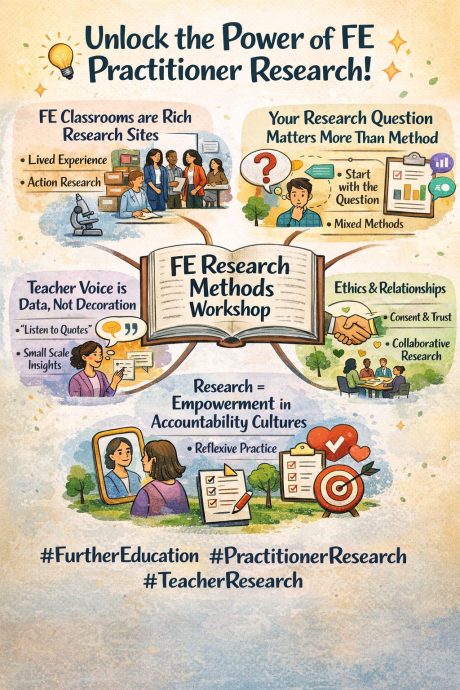
Five Things FE Teachers Can Learn from Small Scale Research
As part of the British Library’s Learning Skills Research Network, Debbie Bogard and I co-led an online Learning and Skills Research Network session exploring research methods and data collection in Further Education. At first I joked that research methods might not be the most thrilling topic. Yet the discussion quickly showed the opposite. When research begins with real classrooms, real teachers, and real learners, it becomes deeply engaging. The session centred on a simple but powerful idea. Small scale practitioner research can generate profound insight. FE classrooms are rich research sites where teachers already observe patterns, dilemmas, and possibilities every day. Research is not something distant or purely academic. It begins with curiosity about practice. Five themes emerged strongly. First, FE classrooms contain valuable knowledge worth studying. Second, the research question matters more than the method. Third, teacher voice is not decoration but a form of data that reveals how systems actually operate. Fourth, ethics sit at the centre of practitioner research because education is fundamentally relational. Finally, research can be empowering. In systems shaped by accountability pressures, inquiry allows teachers to step back, reflect, and understand their work more deeply. The workshop reminded us that practitioner research is not about grand projects. It is about paying attention to practice and learning from it together.
-
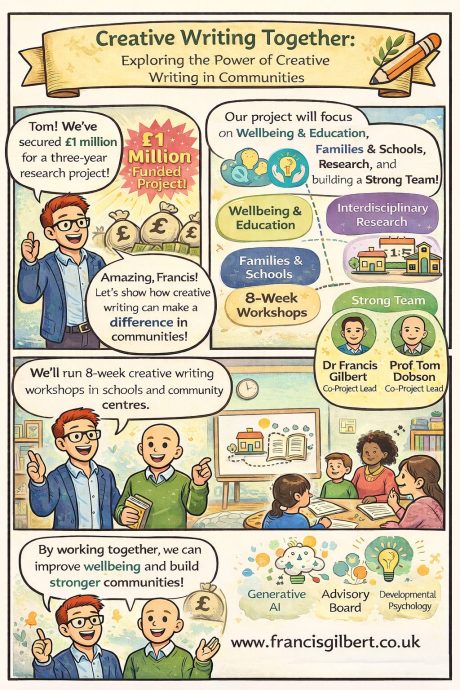
Why Creative Writing Together Matters, A £1m Research Project for Families, Schools and Communities
I am delighted to share that Professor Tom Dobson and I, working with an exceptional interdisciplinary team, have secured close to £1 million in funding for a three year research project, Creative Writing Together. This major award supports an ambitious investigation into how creative writing can strengthen relationships between children, parents, teachers and communities, and enhance wellbeing across educational settings. At a time when schools and families are facing rising mental health challenges, increasing absence and deepening inequalities, we are asking a simple but powerful question. What if creative writing were treated not as an optional enrichment activity, but as a relational practice that helps people understand themselves and one another more deeply? The project centres on the concept of reflective functioning, the capacity to make sense of behaviour in terms of thoughts, feelings and intentions. Strong reflective functioning is associated with secure attachment, improved relationships and emotional regulation. Yet creative writing has rarely been studied as a preventative, community based approach to developing these capacities. Over three years, we will run eight week programmes in schools and community centres in London and York, bringing families and teachers together to write collaboratively. Combining action research, psychological measures and close analysis of participants’ writing, we aim to generate robust evidence and practical resources that can inform policy and practice. Creative Writing Together positions writing as a shared, transformative act. In a fragmented educational landscape, it offers a hopeful vision of creativity as connection.
-
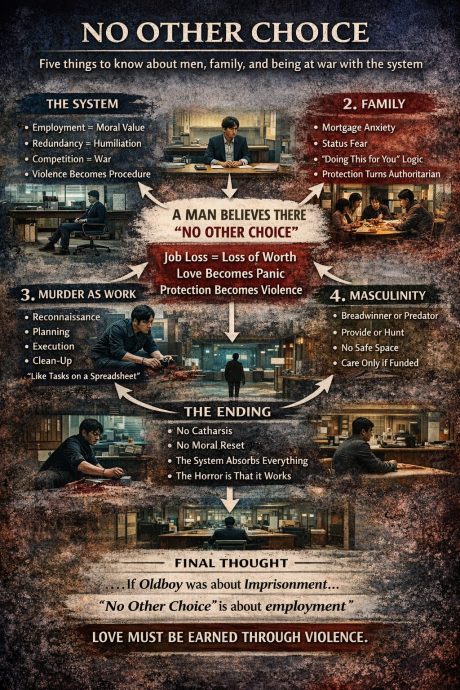
No Other Choice, five things we can learn about men, family, and being at war with the system
I recently watched Park Chan-wook’s No Other Choice, and I cannot stop thinking about it. It is a film that makes you laugh, then makes you question the laughter. In a cinema full of people, there were audible laughs during scenes of murder, not because they were comic in any simple way, but because they were staged with such grim, bureaucratic practicality. The premise is brutally simple. A laid-off paper expert decides to kill his rivals for a job so he can protect his family. What unfolds is not just a thriller, but a devastating portrait of masculinity under neoliberal pressure. When a man’s worth is fused with his wage, unemployment feels like erasure. Love becomes panic. Protection becomes predation. What shocked me most was not the violence, but how easily the system absorbs it. The film suggests that modern corporate life already trains us to think in terms of targets, elimination, competition, survival. If Oldboy was about imprisonment as destiny, No Other Choice is about employment as destiny. It is disturbing, funny, precise, and deeply humane. A film about men, family, and what happens when the system leaves you believing there is no other choice.
-
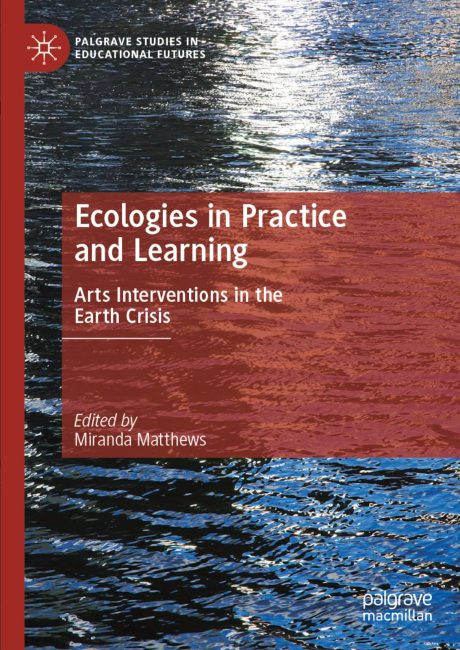
Ecologies of Practice and Learning (Book chapter)
How can creative research help young people become agents of environmental change? This post highlights a chapter I co-authored with Anna Stewart in the edited collection Ecologies in Practice and Learning: Arts Interventions in the Earth Crisis. The book brings together arts educators, researchers and practitioners exploring how learning, creativity and ecological action intersect in a time of environmental crisis. Our chapter draws on the Parklife project, where young people aged eleven to fourteen became co-researchers into a local park. Using poetry, art, film, photography and surveys, they explored safety, ecology and belonging, and presented their findings directly to decision-makers. The result was real change on the ground. The chapter argues for creative, participatory research as a powerful tool for environmental education and democratic engagement, and for parks as classrooms without walls. You can read and download the full article via my website.
-
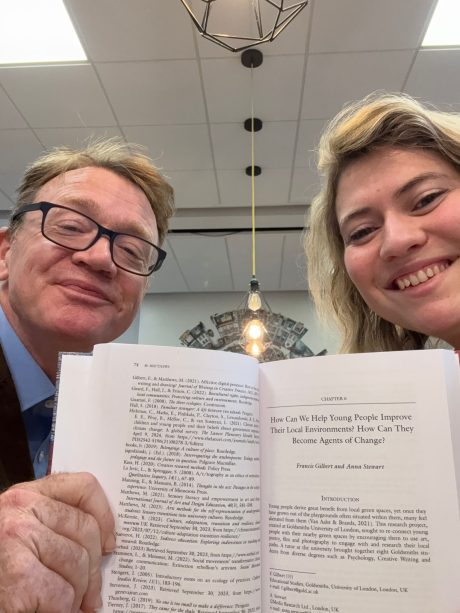
Five reasons to get young people researching their local parks
What happens when we stop seeing young people as a problem in parks, and instead invite them to become researchers, artists and agents of change? This blog, and the chapter it draws on, grows out of the Parklife project, a collaboration between university students, school pupils and local communities. It sets out five reasons why supporting young people to research their local parks matters now. Using creative and participatory methods such as poetry, visual art, film and surveys, the project showed what becomes possible when young people’s insights are taken seriously. Pupils aged eleven to fourteen became co-researchers rather than passive participants. They explored questions of safety, ecology, care and belonging, and presented their findings directly to councillors and park managers. The outcome was tangible change, including improved lighting, better litter management and new community facilities. The research also speaks to wider debates about education, environment and democracy. It challenges deficit narratives about youth, demonstrates the policy impact of creative research, and reimagines parks as classrooms without walls. The article is available open access via the Goldsmiths research repository and is published as a chapter in Ecologies in Practice and Learning: Arts Interventions in the Earth Crisis, situating Parklife within international conversations about socially engaged research and environmental futures. You can read the full copyright-free article here: https://www.francisgilbert.co.uk/2026/02/five-reasons-to-get-young-people-researching-their-local-parks/ Springer book: https://link.springer.com/book/10.1007/978-3-031-82338-1 Goldsmiths repository: https://research.gold.ac.uk/id/eprint/40154/
-
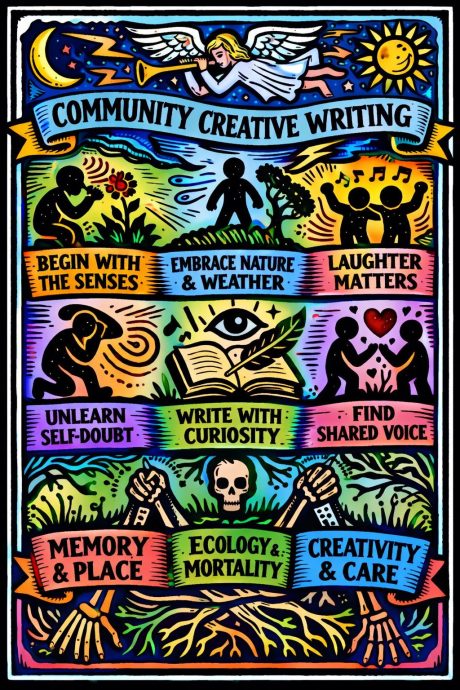
Six ways to engage local communities through creative writing at St Mary’s Church, Walthamstow
St Mary’s Churchyard in Walthamstow is more than a restored historic site. It is a living commons, a place where gardening, conversation, memory, and creativity quietly intertwine. On a January afternoon, we gathered there with students from the MA Creative Writing and Education at Goldsmiths for a community writing session that showed just how powerful local, place-based creative work can be. Led by two MA students, Sophie and Priyanka, the session moved fluidly between sensory attention and playful experimentation. Smell, wind, weather, laughter, discomfort, poetry, and the natural world all became entry points into writing that felt inclusive, serious, and alive. Volunteers and students wrote side by side, discovering that creative confidence grows not through expertise but through permission, attention, and shared experience. What emerged was a practical, replicable model for community creative writing. One that does not demand performance, prizes curiosity over polish, and allows ecological awareness to arise through voice rather than instruction. This post reflects on six key practices from the session, offering ideas for anyone interested in engaging local communities through creative writing, mindfulness, and place.
-
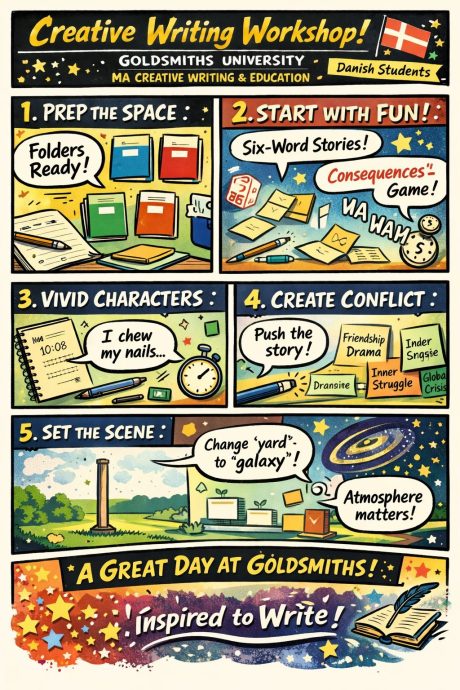
Five Ways to Teach Creative Writing to Teenagers
Forgive the comic strip. It is there simply to convey the energy, playfulness and creative momentum of what was a genuinely joyful afternoon of creative writing at Goldsmiths. Recently we welcomed a brilliant group of Danish teenagers to campus for a creative writing workshop, led by their teacher Margit from DATE and NATE. They arrived full of curiosity, quickly made the space their own, and threw themselves into the session with enthusiasm, laughter and serious thought in equal measure. The workshop was led by three MA Creative Writing and Education students, Niki, Elizabeth and Priyanka, who guided the group through a series of carefully structured but low-stakes activities. From six-word stories and the joyful chaos of Consequences, to thinking about character through one vivid detail, conflict as the engine of story, and setting as atmosphere rather than description, the session offered a clear reminder of what works when teaching creative writing to teenagers. The comic strip gestures towards these ideas in a playful way, but what it really points to is something deeper. Teenagers being welcomed into a university. Future teachers developing their craft. And young writers discovering that language is something to explore and enjoy rather than fear. A brilliant snapshot of the MA Creative Writing and Education in action.
-
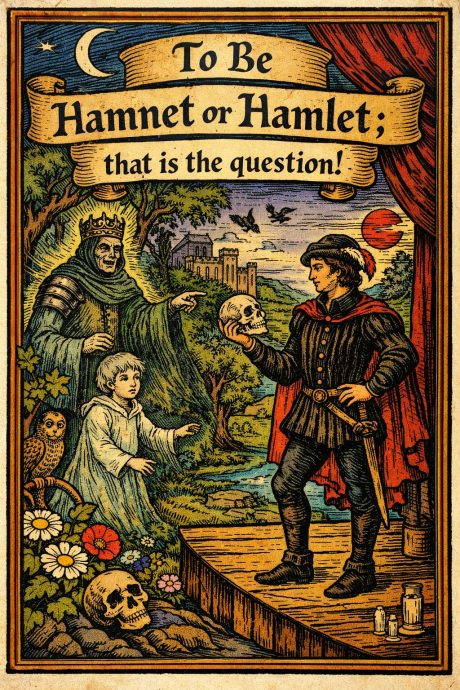
To Be Hamnet or Hamlet; that is the question — Seven lessons I learnt from watching Hamnet
To Be Hamnet or Hamlet; that is the question Seven lessons I learnt from watching Hamnet NB: This review contains spoilers. What if Hamlet is not just a tragedy about revenge, but an unfinished conversation with grief? I watched Hamnet at my local cinema, Crouch End Picturehouse, and came away unsettled, moved, and intellectually provoked. I taught Hamlet for A level English for years and thought I knew the play inside out. This film quietly dismantled that confidence, not by claiming new facts, but by offering a bold emotional reading and asking the viewer to live inside it. The premise is historically sound. Shakespeare’s son Hamnet died aged eleven in 1596; Hamlet was written several years later. What the film explores is what can never be proven, how grief might echo, displace itself, and reappear through art. From Anne Hathaway’s embodied mourning, to forests that seem to think alongside human loss, to the suggestion that Hamlet functions as a kind of family therapy, this is a film that invites big questions. I ended up getting seriously drawn in, researching grief theory, psychoanalysis, family systems, authorship, and early modern ideas of selfhood. Freud sits alongside contemporary bereavement research; Shakespeare studies meet post Covid loss. You will not read a better informed blog on this film. This is a flawed, troubling, and genuinely thought provoking piece of cinema. Shakespeare specialists may wince; others may cry; some people walked out. I recommend it with curiosity rather than reverence. If you’re interested in how stories allow us to enter difficult emotional spaces without explaining them away, this one is for you. If you’re reading this on Instagram, please paste the link into your browser to access the full article.
-

Free Human Givens Therapy Sessions, A Practical and Supervised Offer
I’m currently offering a small number of free Human Givens therapy sessions as part of the final stage of my professional training. This is a practical, solution focused approach that does not require you to talk about childhood trauma unless you want to. The work is often closer to coaching and focuses on challenges you are dealing with now, such as anxiety about work or money, relationships, confidence, or feeling stuck or overwhelmed. All sessions are confidential, ethical, time limited, and fully supervised by an accredited and registered Human Givens therapist. You can read more about my background, training, and approach, including an FAQ, here: https://www.francisgilbert.co.uk/therapy/ If you are interested, please email me at sir@francisgilbert.co.uk . I will reply personally and in confidence.
-

Six Things I Learnt About Home Making from the Film Sentimental Value
Six things we can learn about home making from Sentimental Value What if home is not a place at all, but something we make moment by moment with other people? In Joachim Trier’s Sentimental Value, a Norwegian house becomes a vessel for memory, trauma, silence, and art. The film asks difficult questions about listening, inheritance, history, and how families survive when love is expressed imperfectly or too late. This piece reflects on six lessons about home making drawn from the film, from the way houses remember what people try to forget, to why care cannot be reduced to attentiveness alone, and how home may ultimately be created through reciprocal understanding rather than walls or ownership. The concept map above distils these ideas visually. Read the full blog here: www.francisgilbert.co.uk If you’re reading this on Instagram, please paste the link into your browser to access the full article.
-

Analysis and Study Guide: A Christmas Carol by Charles Dickens
This new ‘Analysis and Study Guide to A Christmas Carol’ is written to help GCSE students genuinely understand Dickens’ novella and write confident, high-level exam responses. It draws directly on my experience teaching ‘A Christmas Carol’ for over twenty years in secondary classrooms, alongside my work as an academic at Goldsmiths where I research the best ways to teach diverse cohorts. Unlike formulaic revision guides, this book focuses on ideas, argument and clarity. It shows students how Dickens shapes meaning through structure, language, character and context, without reducing the novel to lists of quotes or rigid paragraph templates. Each section models the kind of thinking examiners reward, from building a clear thesis to selecting evidence that genuinely supports an argument. The guide includes detailed contextual explanations, accessible critical perspectives, close language analysis, character studies, theme exploration, exam style questions with guidance, creative tasks and speaking activities. The complete text of ‘A Christmas Carol’ is included, with clear, supportive annotations throughout. Written in an encouraging, student friendly voice, this guide works equally well for independent revision, classroom teaching and last minute consolidation. It is ideal for GCSE students aiming for top grades, and for teachers looking for a rigorous, readable resource grounded in real classroom practice.
-
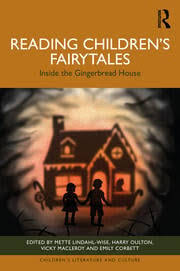
Reading Children’s Fairytales: Inside the Gingerbread House (Chapter)
It’s been a real privilege to contribute to Reading Children’s Fairytales: Inside the Gingerbread House (Routledge), a genuinely collaborative and intellectually generous volume edited by an outstanding team with strong roots in Goldsmiths, University of London. The book is edited by Dr Mette Lindahl-Wise and Dr Harry Oulton, both PhD graduates of Goldsmiths’ Education department, alongside Professor Vicky Macleroy, now Emerita Professor and still a hugely influential presence in the field, and Dr Emily Corbett, Head of the MA in Children’s Literature and a tireless champion of children’s and young adult literature. Their collective vision has shaped a book that is rigorous, creative, inclusive, and genuinely interdisciplinary. The volume brings together leading and emerging scholars, practitioners, and creative writers to explore the enduring power of Hansel and Gretel across children’s and young adult literature, art, and culture. It includes a chapter by Professor Michael Rosen and an introduction by Jack Zipes, widely regarded as the world’s leading authority on fairy tales, setting the intellectual tone for the collection. Across the book, contributors examine retellings of Hansel and Gretel in picturebooks, graphic novels, poetry, YA fiction, sculpture, and Hip-Hop, challenging narrow, hierarchical, and canonical approaches to fairy tales. The result is a rich, dialogic collection that celebrates multiple forms of knowledge, multimodal meaning-making, and culturally responsive approaches to children’s and young adult literature. If you’re reading this on Instagram, please paste the link into your browser to access the full article.
-

The Oxford Handbook of Creativity and Education (Chapter)
I’m pleased to share that I’ve contributed a chapter to The Oxford Handbook of Creativity and Education (Oxford University Press, 2025), a major international reference work bringing together leading research on creativity in education from across the world. The handbook explores how creativity is understood, supported, and constrained across educational systems, with chapters examining policy, assessment, curriculum, classroom practice, disciplines, and research methods. It is designed for students, researchers, teacher educators, school leaders, and policymakers interested in the future of creativity in learning, teaching, and leadership. My chapter, Using Creative Writing to Fuel Creativity, focuses on the role of creative writing as a core pedagogical practice rather than a marginal or optional one. Drawing on research and my own experience in schools and universities, I argue that creative writing can support creativity across many disciplines, not only English and the arts, but also science, social science, psychotherapy, and research practice. The chapter explores practices such as freewriting, flow-based writing, reflective writing, and my own concept of diagrarting, combining writing, drawing, and dialogue. It also engages critically with assessment, high-stakes accountability, decolonising pedagogy, and the limits of traditional creative writing workshop models. Central to the argument is the idea that how and why we teach creative writing shapes learners’ confidence, agency, and capacity for creative thought. The full chapter is published by Oxford University Press and is copyrighted. I’m able to share a PDF of the final draft (with one figure missing), which contains most of the argument and can be read alongside the published version in the handbook. If you’re reading this on Instagram, please paste the link into your browser to access the full article.
-
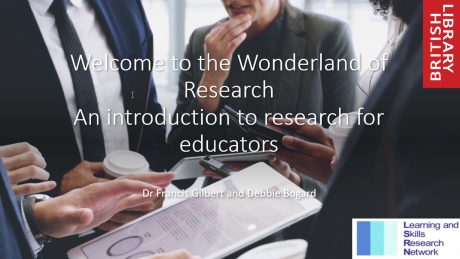
7 Ways For Teachers to become Researchers
In December 2025, I delivered an online session for FE lecturers as part of the British Library Research Network, working with Debbie Bogard of the British Library. We explored seven things every teacher should know about research, using the original Alice in Wonderland manuscript as a metaphor for how inquiry really works. Research is never perfect or polished. It is exploratory, creative, full of revision and curiosity, just like a teacher’s everyday practice. We introduced practical ways to develop a research question, map its key ideas, choose an appropriate methodology, evaluate the credibility of data, and create a meaningful literature review. We also encouraged lecturers to think about more imaginative forms of sharing findings, including podcasts, infographics and multimodal projects. Examples from the Parklife project showed how creative participatory research can have a significant impact on communities and young people. The central message of the session was that research is an act of professional courage. It is not reserved for academics. With the support of the British Library Research Network, FE educators can shape their own inquiries, strengthen their critical thinking, and generate new knowledge that benefits learners and the wider sector.
-

Honouring the Humanity of an Exceptional Student: Zhe Wang
The conclusion of the trial into the tragic death of Zhe Wang has brought renewed sadness to our community, but it also reminds us of the importance of remembering who she was beyond these events. Zhe was a gentle, attentive presence on the MA Creative Writing and Education, someone whose calmness and kindness shaped the spaces she entered. Her writing revealed a rare sensitivity to nature, stillness, and the quiet movements of thought, offering readers a way to slow down and reconnect with the world. Her classmates honoured her with great care, gathering her poems and prose into a beautifully produced anthology that reflects both her creativity and the affection she inspired. As we commemorate her, we hold close her humanity, her thoughtful way of being, and the luminosity of her work. Through her words and through our remembering, Zhe’s presence continues to shine.
-
Five Things We Should Know About Irish Identity Abroad
In this Mindful Learning podcast, Francis Gilbert talks with MA Creative Writing and Education graduate Conor Patchell about his remarkable dissertation film on Irish identity abroad. Conor reflects on the stories he inherited from his grandfather about discrimination in England, the resilience of earlier generations, and the dramatic shift from suspicion to celebration that Irish people have experienced over seventy years. He explains how today’s warmth towards Irish culture rests on the labour, humour, and decency of migrants like Ann, Patsy, John, and Vincent, whose voices shape his film. Conor describes his own experience as “a popular immigrant” and speaks with gratitude about those who “paved the way for us”. This extract gives readers a glimpse into a deeply mindful exploration of migration, memory, and belonging. If you are reading this on Instagram, please paste the link into your browser to access the full article.
-
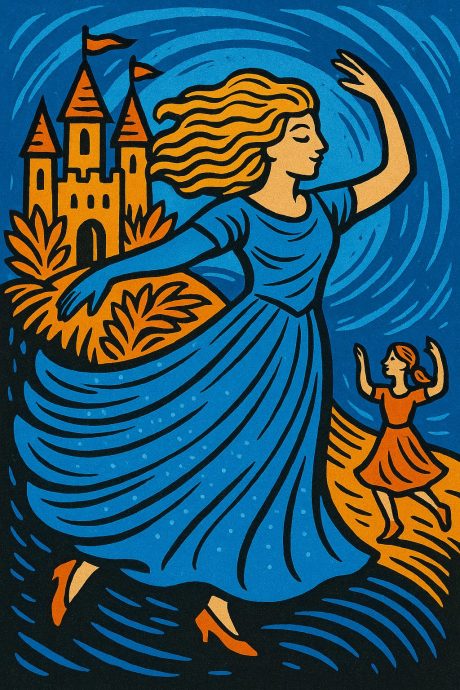
The Healing Dance: Human Givens, Catharsis, and the Power of Stories
After more than thirty years of teaching, writing, and listening to people share their work and their worries, I’ve come to believe that stories don’t just entertain or instruct us; they heal us. In this post, I explore how narrative and imagination can restore emotional balance, drawing on my recent training in the Human Givens approach to therapy. During one of my training sessions, I worked with a woman I’ll call Anna, a dance teacher who had been sidelined by a younger colleague. I invited her to relax and told a simple story about a dancing queen who built a palace of movement and joy. When a former pupil tried to claim the palace as her own, the queen didn’t fight, she danced again. Her rhythm filled the hall and reminded everyone where the music had begun. As Anna listened, tears came — not from distress, but from recognition. The story acted as a mirror, reflecting her creative worth back to her. It wasn’t interpretation that healed her, but the moment when the story met the truth she’d carried inside all along. From Aristotle’s notion of catharsis to modern neuroscience and the Human Givens idea of “raising the emotional template,” this post explores how guided story and metaphor can help us complete interrupted stories, transforming chaos into coherence. When we re-story our experiences with compassion, the body listens, and healing begins.
-
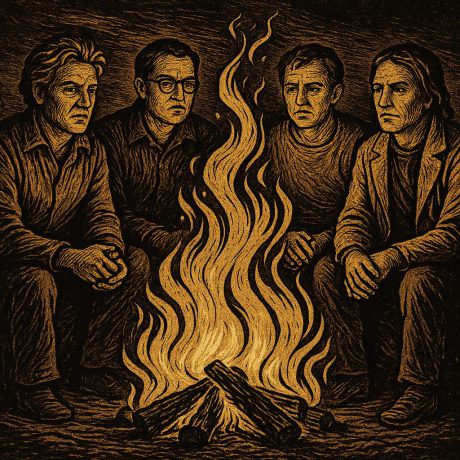
If I Were to Hold a Retreat for Entitled Men
🔥 If I were to hold a retreat for entitled men, I’d start with a fire. Kelly Reichardt’s The Mastermind (2025) burns with quiet devastation. It’s not a heist film but a parable — a portrait of what happens when unmet needs twist imagination into delusion. Drawing on the Human Givens approach and ideas from The Mindful Creative Writing Teacher (Gilbert, 2024), this reflection explores how men lose themselves when creativity serves ego rather than empathy. Read the full essay: The Mastermind: A Parable for Entitled Men and the Search for Meaning 🕯️ For teachers, therapists, and fathers alike, it asks one question that lingers long after the flames fade: What is it you really need? WARNING: This post contains plot spoilers for the film, The Mastermind (2025)!
-
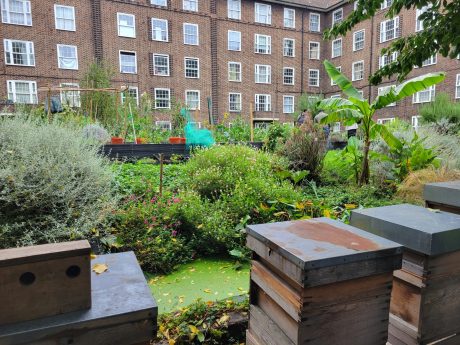
Writing Among Books and Roses: Five Lessons from the British Library and a South London Garden
This October, as autumn mist drifted across London, our MA Creative Writing and Education students embarked on two journeys that revealed how creativity grows wherever attention is cultivated — one in the British Library, the other in a South London garden. At the British Library, students began by getting their Reader’s Passes, a small but symbolic act of entry into a world of ideas. Each went on a quiet quest to find a book, manuscript, or object that spoke personally to them. One student of Mauritian heritage discovered colonial-era texts that illuminated her island’s past; another, from India, was drawn to the gleam of jewellery that recalled her grandmother’s only inheritance — her bangles. These encounters sparked reflective, poetic responses, showing how archives can awaken ancestral memory and imaginative connection. Later that week, the group met Ian, the Head Gardener — @theelephantgardener — who, with volunteers and modest grants, has transformed an estate’s communal garden into a flourishing haven of rhubarb, roses, and vegetables. The students weeded, listened, and wrote, finding that creative writing, like gardening, begins with observation and care. Both experiences taught us that creative writing doesn’t belong only to the elite or to “literary” spaces. It is a democratic, sensory practice that helps us connect — with the past, with nature, and with one another. Like Keats’s “Season of mists and mellow fruitfulness,” October reminded us that writing and gardening share a rhythm: gathering what’s ripe, planting what’s next. The writers are now planning projects to use libraries and gardens as creative classrooms — helping children, elders, and communities to grow stories from the soil beneath their feet.
topics I’ve written about on this site
- Archived (444)
- Creative Writers (16)
- FGI Publishing (34)
- Dr Jekyll & Mr Hyde: A dramatic adaptation of Stevenson's classic novel (2)
- Dr Jekyll & Mr Hyde: The Study Guide Edition (4)
- Far From The Madding Crowd: A Study Guide (2)
- Frankenstein: A Study Guide (2)
- How to Get a Great English Degree (2)
- Jane Eyre: A Study Guide (2)
- Learning Matters (2)
- Pride and Prejudice: A Study Guide (2)
- Songs of Innocence and Experience: A Study Guide (2)
- St. Cupid's (1)
- Star-crossed: Romeo and Juliet for Teenagers (2)
- The Hound of the Baskervilles: A Study Guide (2)
- The Long Game (6)
- The Mindful Creative Writing Teacher (2)
- The Mindful English Teacher (1)
- The Strange Case of Dr Jekyll and Mr Hyde: A Study Guide (2)
- The Turn of the Screw: A Study Guide (2)
- Wuthering Heights: A Study Guide (2)
- For (189)
- for academics (55)
- for parents (33)
- for students (97)
- for teachers (84)
- Therapists (13)
- Key concept (232)
- Academies (13)
- Admissions (5)
- Aesthetic autobiography (5)
- Analysing autobiography (4)
- Analysing quotation (5)
- Autobiographical classroom materials (4)
- Bullying (4)
- Child Language Acquisition (17)
- Choosing A Secondary School (3)
- Collective Identity (4)
- Communication (10)
- Comparison (5)
- Creative writing and therapy (8)
- Creative Writing Teaching (29)
- Curriculum change (8)
- Digital learning (6)
- Discipline (27)
- Education reform (59)
- English Baccalaureate (4)
- Free Schools (6)
- International comparisons of schools (2)
- Language Development (5)
- Media Studies (6)
- Mindfulness (8)
- Model answers (3)
- Ofsted (4)
- Punishments (4)
- Reading Reform (11)
- Resources (3)
- Reviews (13)
- School entrance (5)
- Semantic change (2)
- Specialist teachers (4)
- Student Voice (2)
- Teacher training (17)
- Teaching Unions (4)
- The Publishing Industry (13)
- Yob culture (12)
- Media appearances (35)
- BBC 2 Newsnight (2)
- BBC Breakfast (5)
- BBC News (2)
- BBC Radio3 (6)
- BBC Radio4 (5)
- BBC Radio5 Live (10)
- Channel 4 News (1)
- Channel 5 News (3)
- GMTV (2)
- ITV News (1)
- Sky News (1)
- Mindful Learning Podcast (9)
- My books (38)
- Anthologies (4)
- Fiction (4)
- Non-fiction (10)
- Study guides (17)
- Opinion (239)
- Published in (239)
- Academic articles (31)
- Blue Door Press (6)
- English Online (2)
- Local Schools Network (35)
- Long Game Articles (6)
- Mumsnet: talesbehindtheclasroomdoor (3)
- NAWE Magazine (2)
- Newsweek (1)
- Politico.eu (1)
- Reviews (1)
- Teachit.co.uk (1)
- The Big Issue (2)
- The Daily Mail and Mail on Sunday (8)
- The Daily Telegraph (24)
- The Evening Standard (3)
- The Guardian (43)
- Comment Is Free (29)
- The Local Schools Network (9)
- The New Day (1)
- The New Statesman (7)
- The Observer (4)
- The Tablet (1)
- The Times and The Sunday Times (33)
- The Times Educational Supplement (10)
- The Western Daily Press (6)
- The Yorkshire Post (4)
- Titles (31)
- UK education system (90)
Five Things I Learnt About Winning from Marty Supreme
What does it really mean to win? I went to see Marty Supreme expecting a sports movie, or at least a film about ambition. What I came away with was something darker and more unsettling. A portrait of winning at all costs, and the quiet wreckage left behind when success becomes the only value left standing. Ping pong is treated with utter seriousness in this film. No irony, no wink. It becomes a lens through which we watch a man climb, dominate, discard, and hollow himself out. Marty wins matches, lovers, money, status. He also abandons people, humiliates himself, and loses any capacity for kindness or care. The film’s greatest strength is its visual world. 1950s Manhattan, the shoe shop, the light, the textures, the labour. These spaces quietly tell a story Marty refuses to hear. Winning lifts him out of community and leaves him alone with his trophies. This blog reflects on five things the film taught me about winning, losing, seriousness, vulnerability, and why ambition without ethics ends up looking absurd rather than heroic. If you are interested in culture, education, masculinity, parenting, or what we teach children about success, this film, and this moment, are worth thinking about. Read the full piece on my website. If you’re reading this on Instagram, please paste the link into your browser to access the full article.